
Read beyond your field with weekly science letters
How can you explore a neighbouring field without starting with hundreds of abstracts? SummarizePaper’s weekly letters tell the story of selected findings and connect them to their sources. You can browse the explanation, listen by chapter and choose one paper to investigate.
We will follow Physics of matter and light, 26 October 2026. The edition connects confined water, clocks, quantum gases and magnetism. Our thread will be how three-dimensional imaging reveals a chain of magnetic defects. We will move from the story to a CC BY paper, its figure and a reading note.
1. Choose a theme that broadens your reading
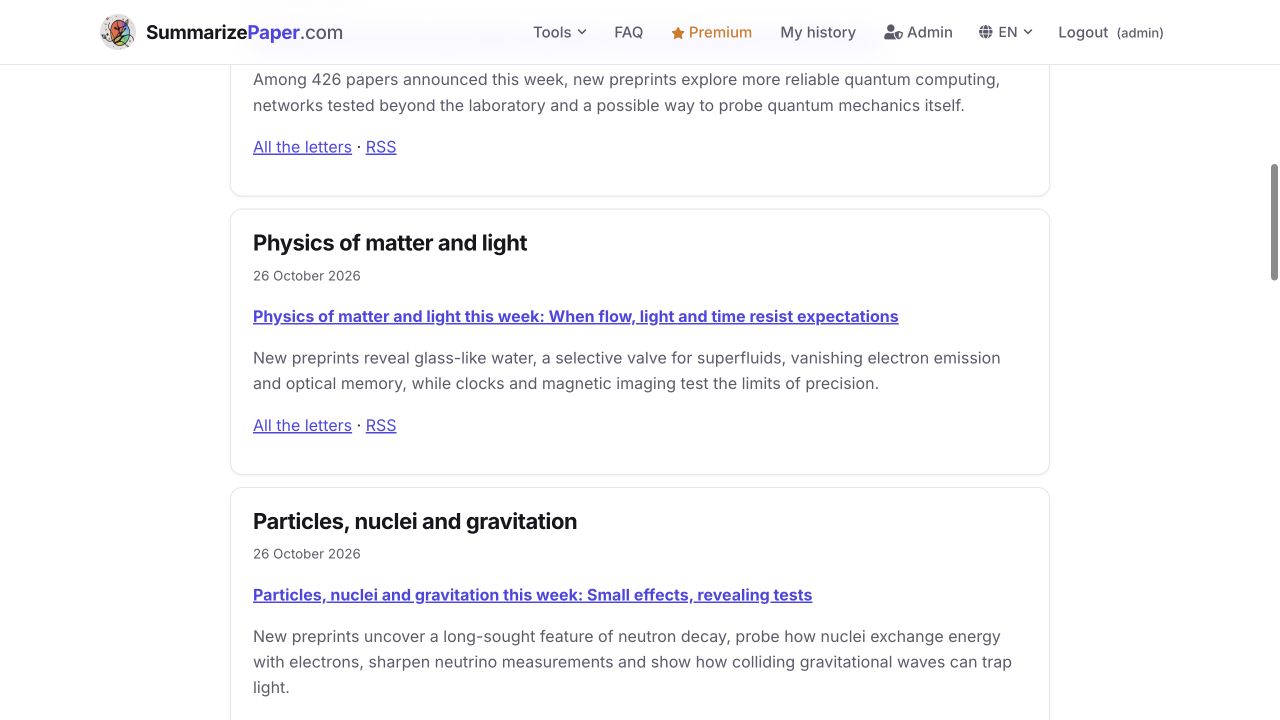
Open Weekly letters. Eleven themes range from AI to the brain, mathematics and economics. Each card gives a field, date, title and preview.
For this example, choose Physics of matter and light. The title introduces several stories, allowing you to pick one without already knowing every method involved.
2. Find a dated edition and its RSS feed
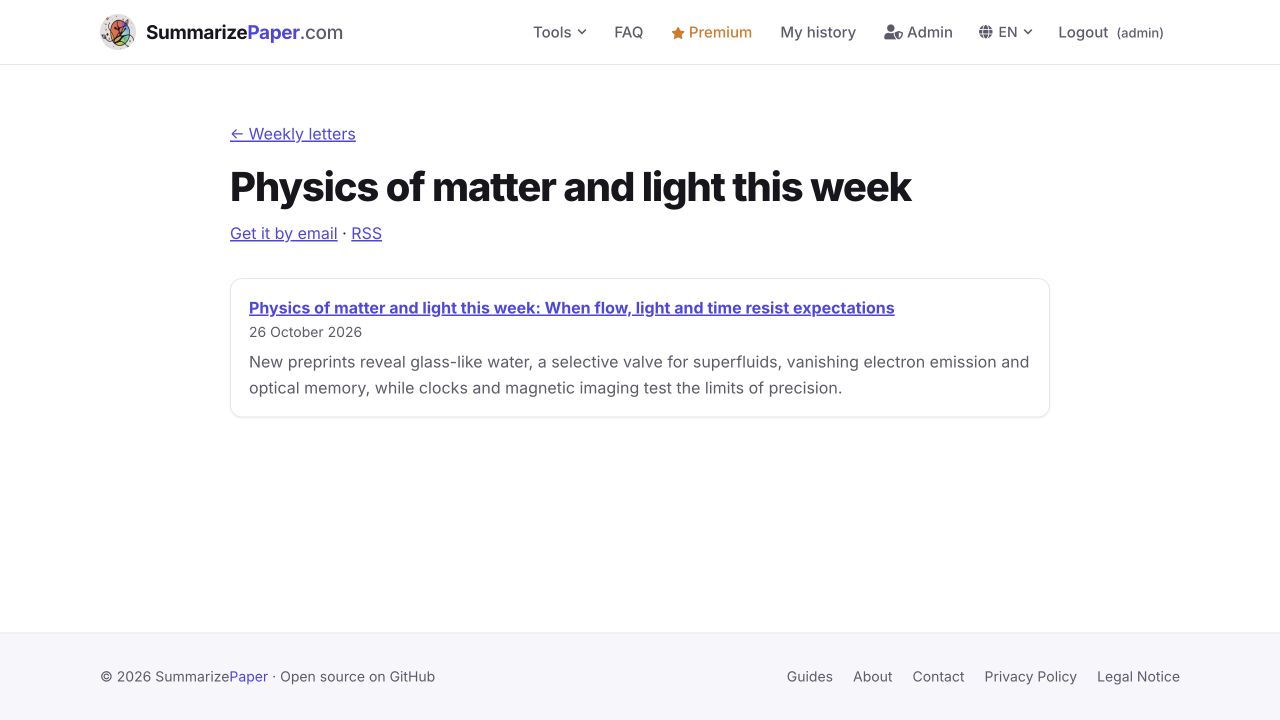
All the letters lists the theme’s available editions. Choose 26 October 2026 and keep the date with any information you take away. The theme RSS feed lets you follow new editions in a feed reader; another feed gathers every theme.
French and English versions tell the same selection with their own wording. The edition date should not be confused with each paper’s publication year.
3. Choose email delivery in the right language
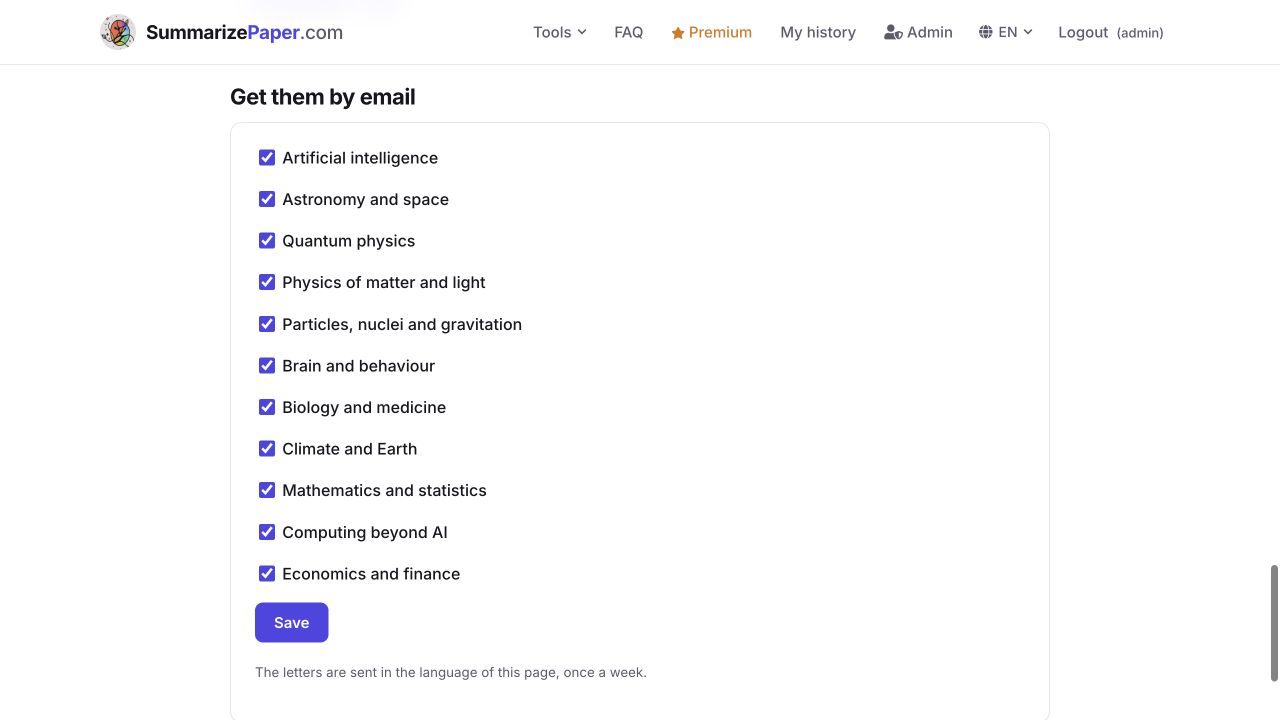
At the bottom of the letters page, Get them by email lets you select themes. A free account can receive one chosen letter; Premium allows several and adds features including listening.
First open the page in your desired language, select themes and press Save to apply the preferences. The form states that weekly delivery uses the language of this page. The screenshot shows a Premium account’s multiple choices; the free form offers one choice.
RSS offers another route if you prefer to gather editions in your usual feed reader.
4. Read the letter as an entry point
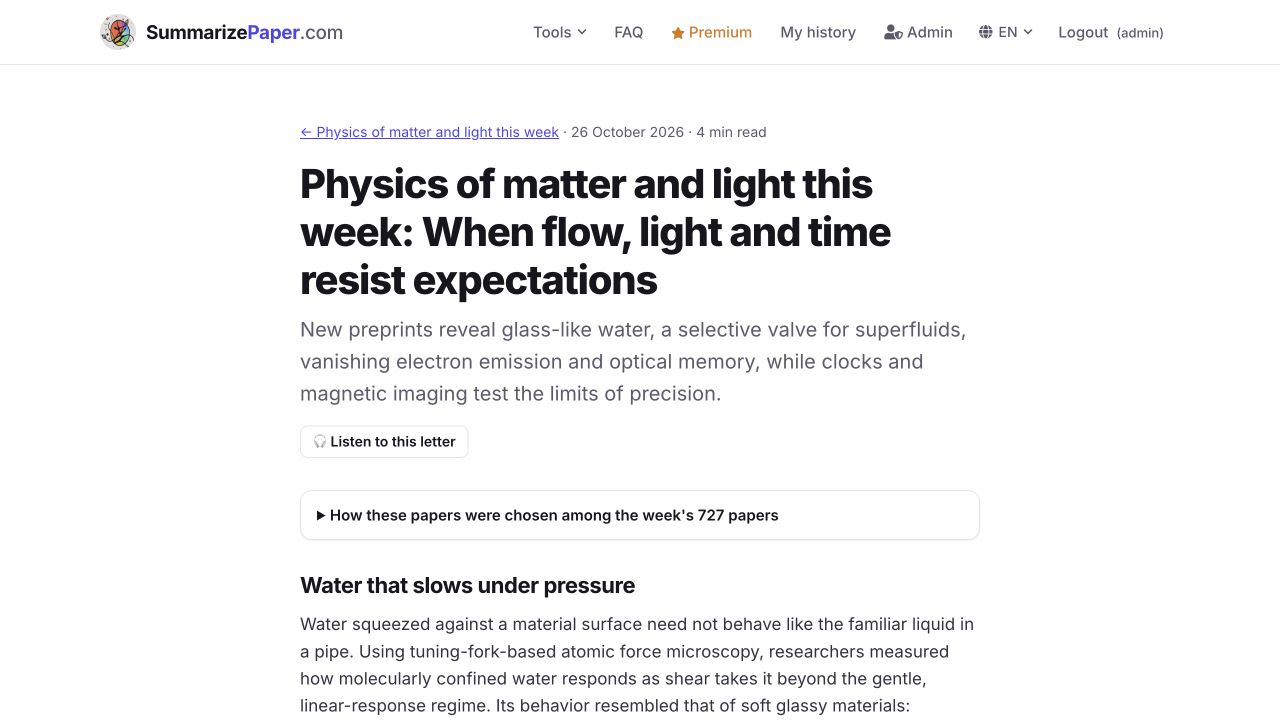
Open the 26 October edition. Its introduction connects how confinement, geometry and interactions change the transport of matter, light and information.
The edition contains six findings. Its displayed reading time helps you choose between browsing the story and investigating one subject. For this example, go to Magnetic singularities form a chain, the sixth section.
The story is written by AI from selected sources. An accessible explanation helps establish why a paper is worth reading; the paper supplies its demonstration.
5. Understand how the papers were chosen
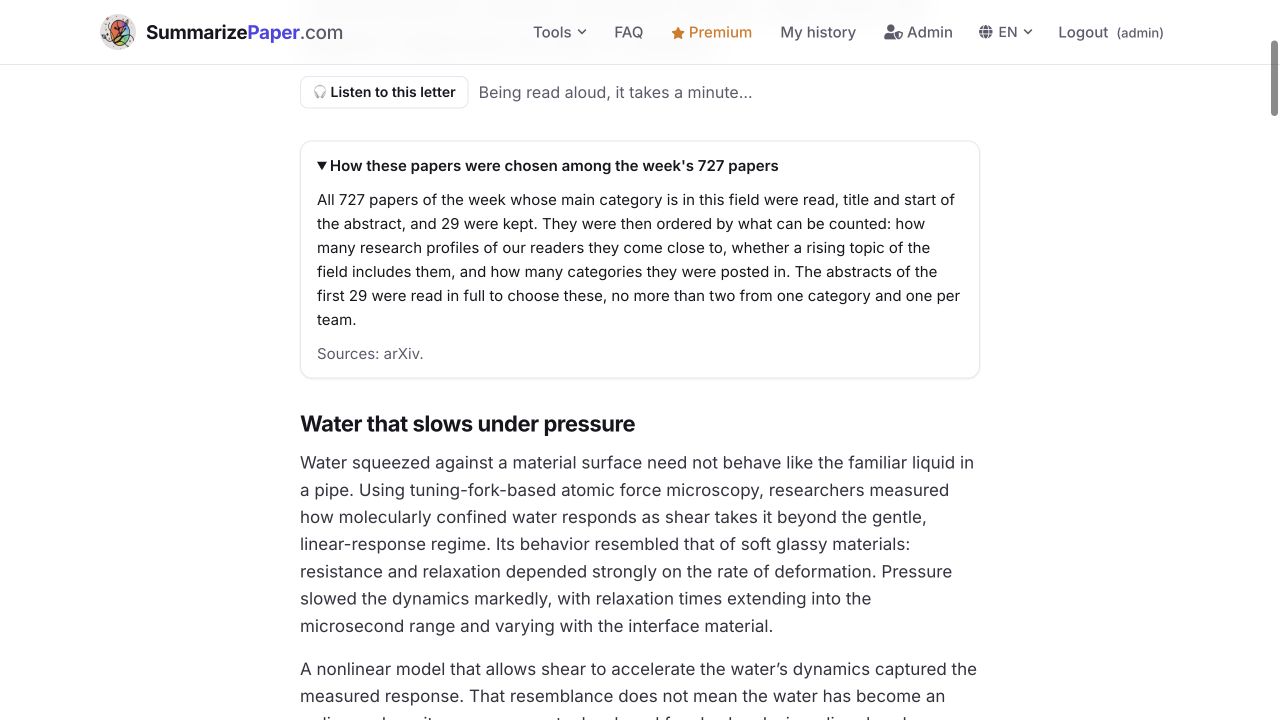
Expand How these papers were chosen. For this edition, the panel describes screening 727 papers whose main category belongs to the field through titles and abstract openings, retaining 29. Those 29 abstracts were then read in full to choose the selection, with no more than two papers per category and one per team.
Reading an abstract in full is different from reading the full paper. The panel makes the selection scope visible; it does not establish completeness or definitive validity. We will check the source used for the chosen paper’s synthesis separately.
6. Choose an observation and its limitation
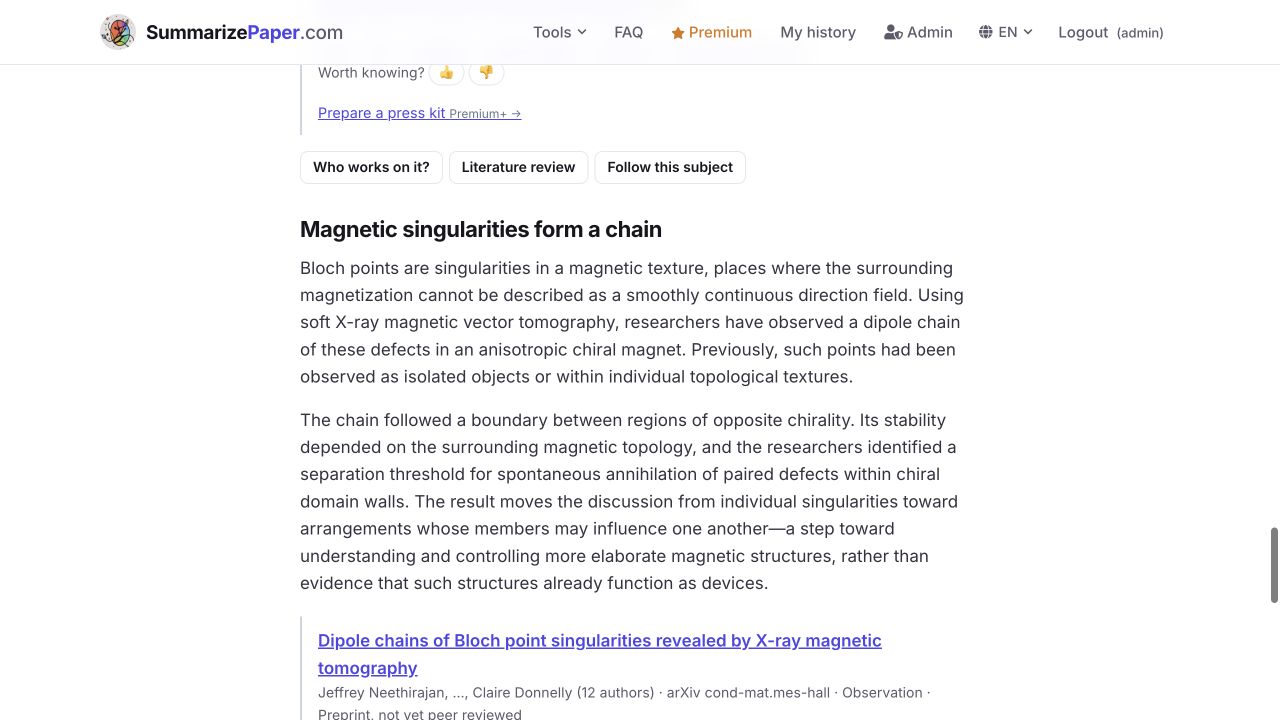
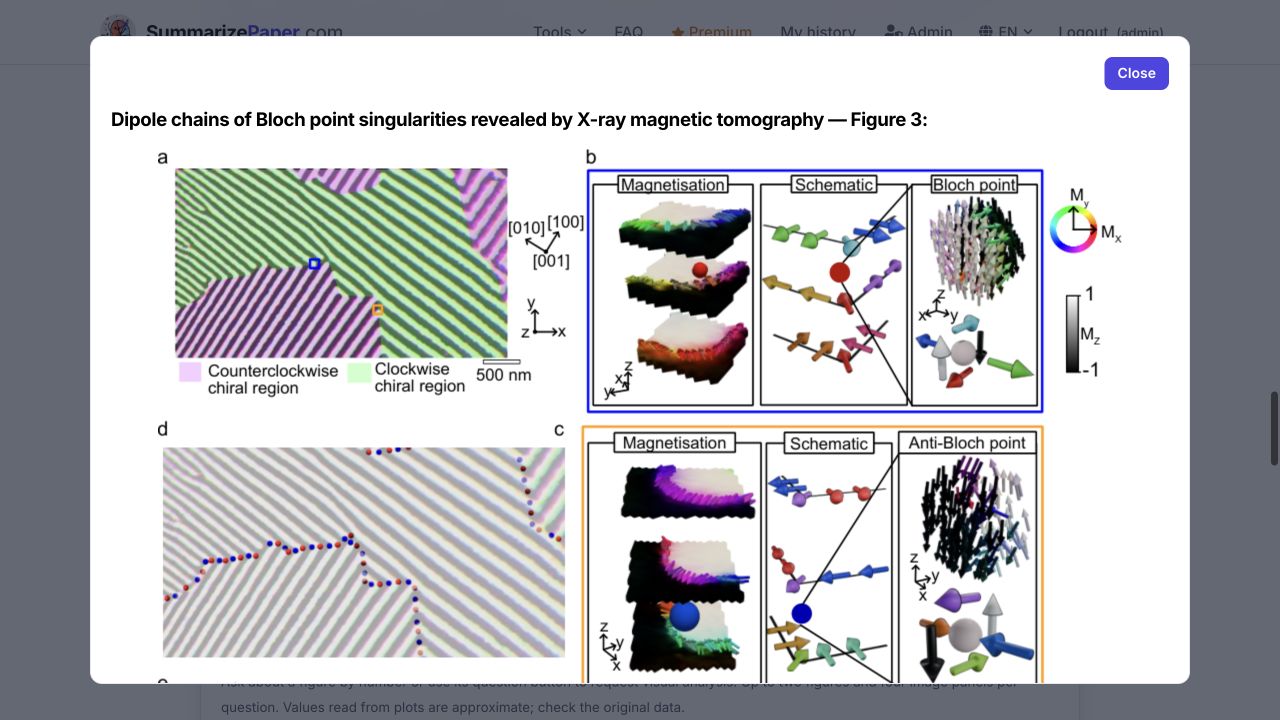
The magnetic-defects section explains how X-ray tomography reconstructs magnetisation in three dimensions. The authors identify a chain of Bloch points and anti-Bloch points at a boundary between regions of opposite chirality.
Its final sentence sets a concrete limit: observing a stable chain does not establish individual control over its defects. Take that question to the paper: what was observed, and what remains to be achieved?
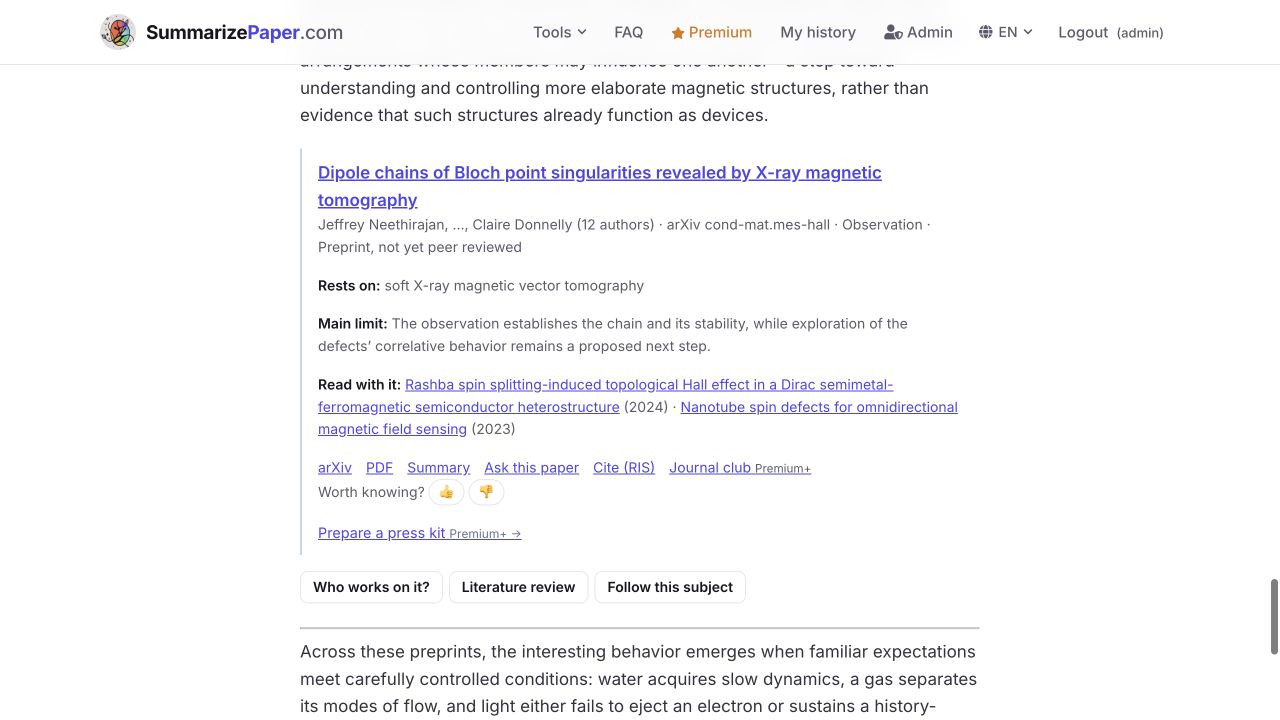
Below the story, the card for Dipole chains of Bloch point singularities revealed by X-ray magnetic tomography displays:
- Observation, as its study type;
- Preprint, not yet peer reviewed, as the displayed status;
- Rests on, identifying magnetic tomography;
- Main limit, highlighting that individual control has not been demonstrated.
Read with it suggests related readings; check their scientific connection before treating them as essential references. arXiv, PDF, Summary, Ask this paper and Cite buttons provide routes forward. Scientific titles and short source excerpts may retain their original language.
7. Listen to a specific chapter
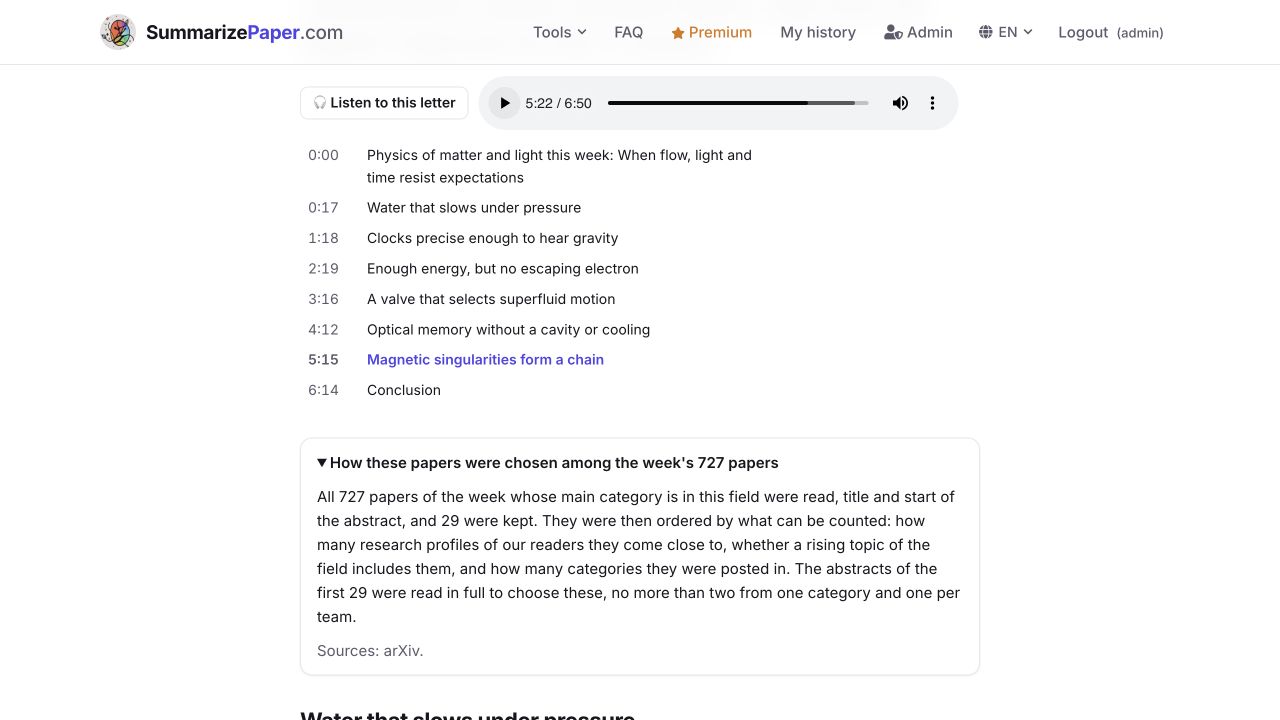
With Premium, Listen to this letter prepares audio in the edition’s language. Once the player is ready, chapters take you straight to a finding. The magnetic chapter starts at 5:15 in English and 5:25 in French in this example; timing differs between languages.
Play, pause or revisit a chapter. The silent-reading estimate and audio duration need not match. Listening helps introduce the story; return to the source for figures, equations and uncertainties.
8. Check the full text and figures
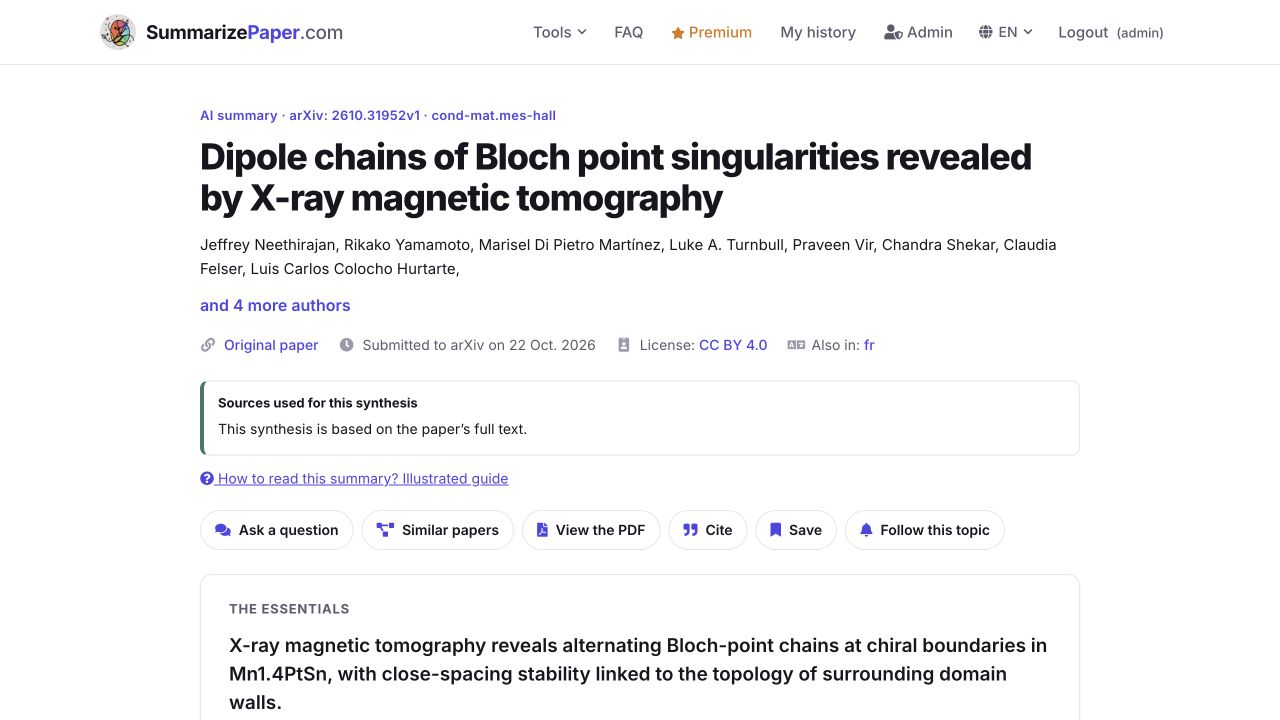
Open the Bloch-point paper page. It shows CC BY 4.0 and This synthesis is based on the paper’s full text. Its arXiv submission is dated 22 October 2026, four days before the edition.
Method and Limitations expand what the letter summarizes: a magnetisation reconstruction, finite spatial resolution and possible artefacts from limited-angle tomography. Observing the structure does not establish dynamic manipulation of its defects.
Check the source banner paper by paper. Full text in this example does not mean every paper in a letter is analyzed in full. The summary guide explains these labels.
In Figures and plots, this version offers ten figures, including appendices. Enlarge Figure 3. The screenshot shows, in particular, panels a–d: regions of different chirality, reconstructions and local schematics, then the chain’s mapped positions.
Distinguish reconstructions from schematics. Red and blue markers help locate Bloch and anti-Bloch points; they are not photographs of atomic-scale cores. A useful question would be: “Which panels establish the chain, and what does measurement resolution limit?”
Find the figure in the original paper.
9. Take the papers into a workspace
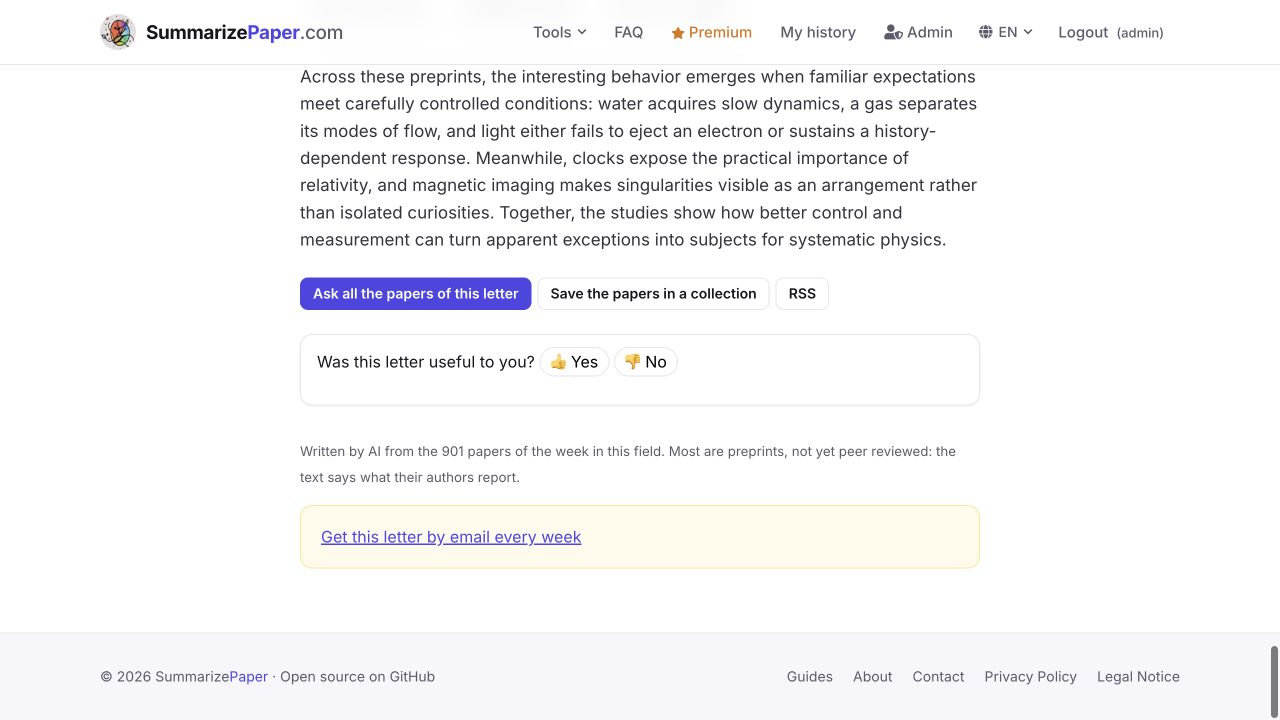
At the end of the letter, choose Ask all the papers of this letter or Save the papers in a collection. The former opens a corpus in the chat; check its loaded sources before asking a cross-paper question. The latter preserves references for follow-up reading.
A useful comparison might ask: “Which studies rely on measurements, reconstructions or simulations, and what limitations distinguish them?” Sharing an edition does not make every aspect of the studies directly comparable.
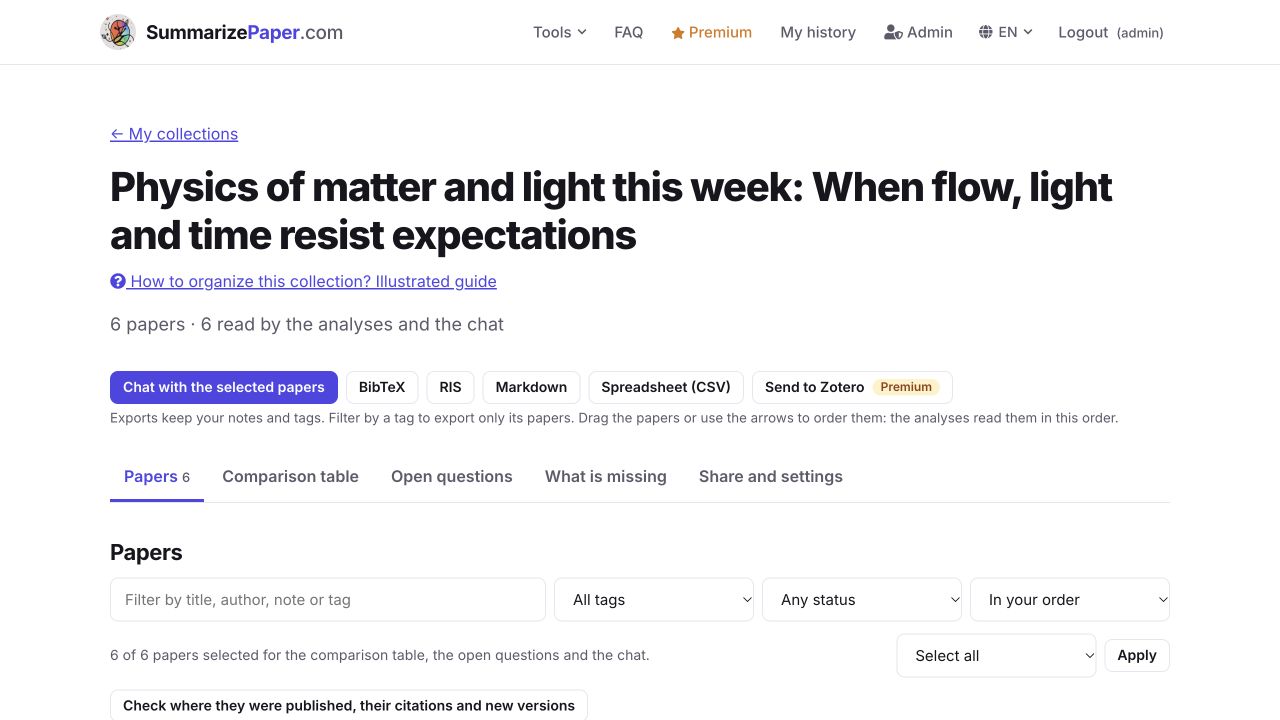
Here the save button creates a collection containing the edition’s six papers. The folder takes the letter’s title and provides bibliographic exports and collection tools.
The selected-paper count identifies the corpus passed to analysis tools; it does not certify that all six full texts are available.
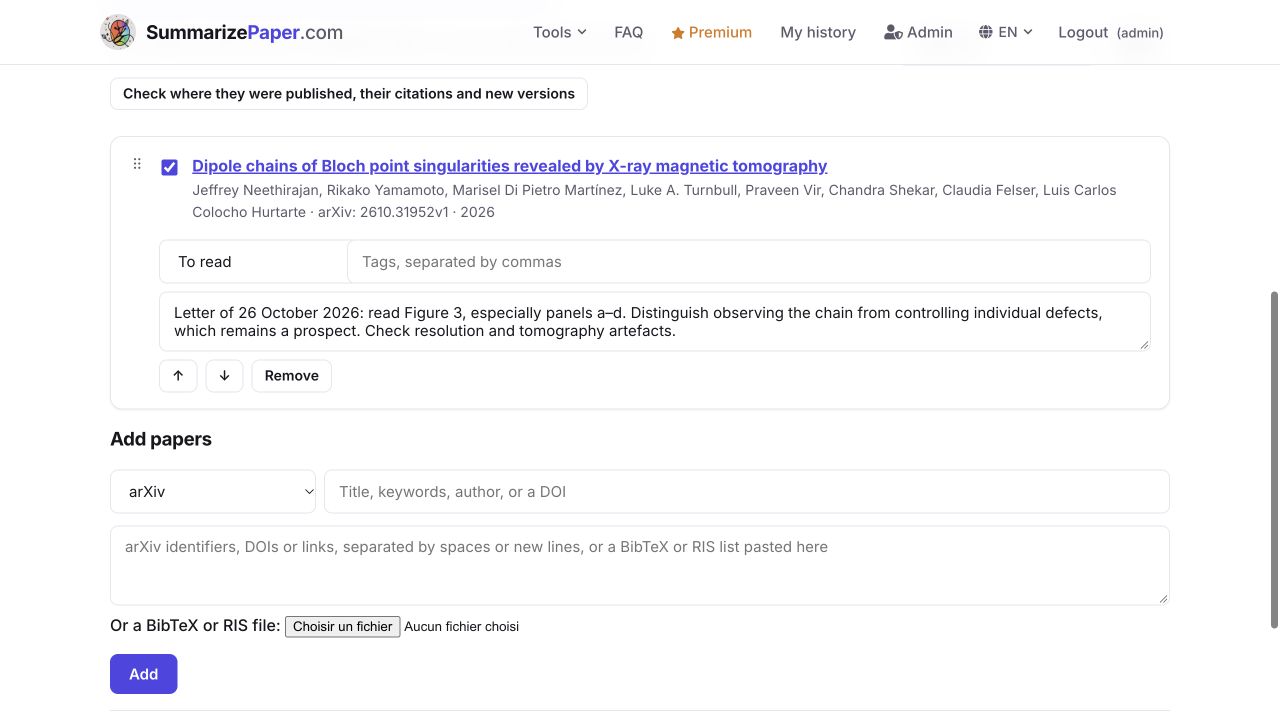
Filter the folder with Bloch, set To read and add a note. Here the note preserves the edition date, Figure 3, the difference between observation and control, and checks on resolution and artefacts.
That keeps the reason for your interest alongside the reference. Collections organize the readings, while paper chat helps formulate and verify precise questions.
For a regular queue close to your research, use the digest. For activity around specific vocabulary, open Rising topics. A letter provides a recurring reading route into what is happening beyond your field.
Choose your next reading beyond your specialty
Discover weekly science letters