
Collections: prepare a journal club on Sagittarius A*
You are preparing a journal club on the first image of Sagittarius A*. One paper gives the overall result, another explains image reconstruction, and a third tests gravity. How do you keep their contributions straight and quickly find what you need to explain?
Use Collections to build a working dossier: a note and reading priority for each paper, a selection for your talk, then a comparison with supporting passages. This guide follows a demonstration actually completed with three EHT publications.
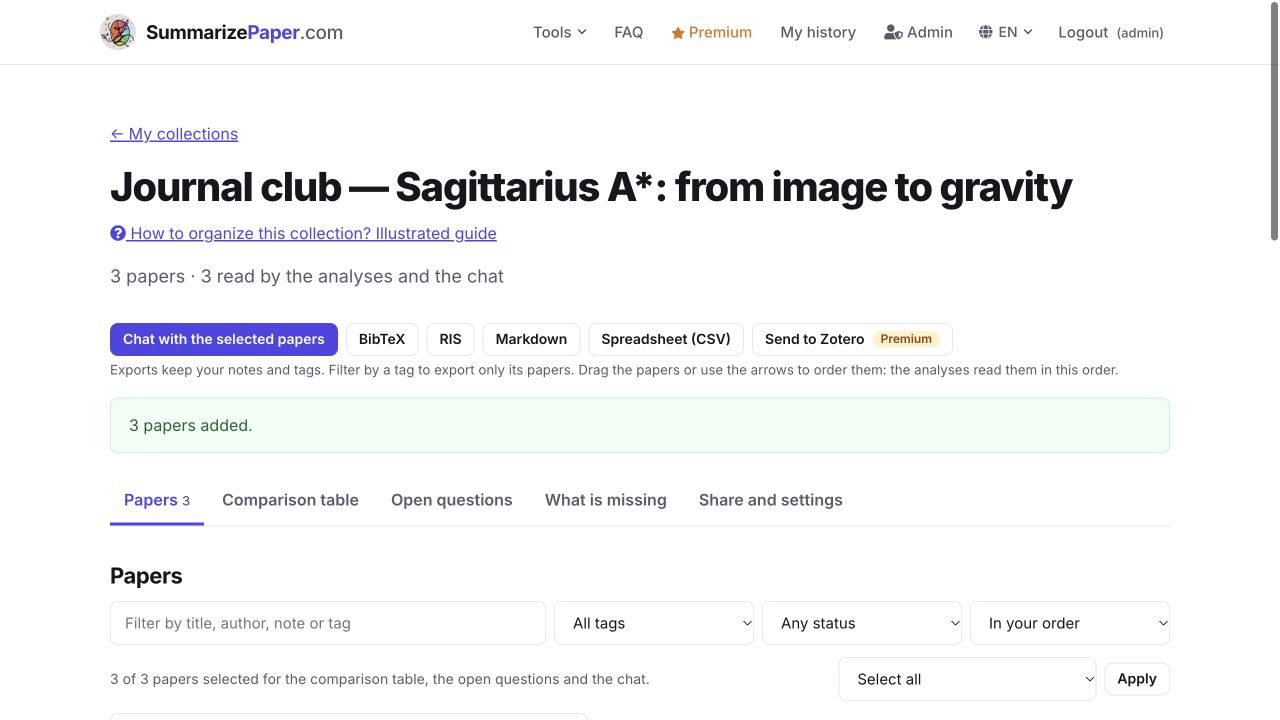
Choose papers with different roles
All three papers were published in 2022 and deposited on arXiv in November 2023. We use the versions below, all under CC BY 4.0 and available in full text. The year displayed on the cards is their journal publication year.
| Paper | Role in our preparation |
|---|---|
| I — Overview | Introduce the image, measurements and overall interpretation. |
| III — Imaging | Understand image reconstruction and its uncertainties. |
| VI — Metric tests | Separate the observed ring from the inferred shadow and examine tests of gravity. |
This small corpus is a focused starting point. The papers analyze the same 2017 EHT campaign: they provide complementary contributions, rather than three independent observational confirmations.
Create the collection and import the references together
Open Collections, sign in and create “Journal club — Sagittarius A*: from image to gravity”. Under “Add papers”, paste these identifiers, one per line, then click “Add”:
2311.08680v2
2311.09479v1
2311.09484v1
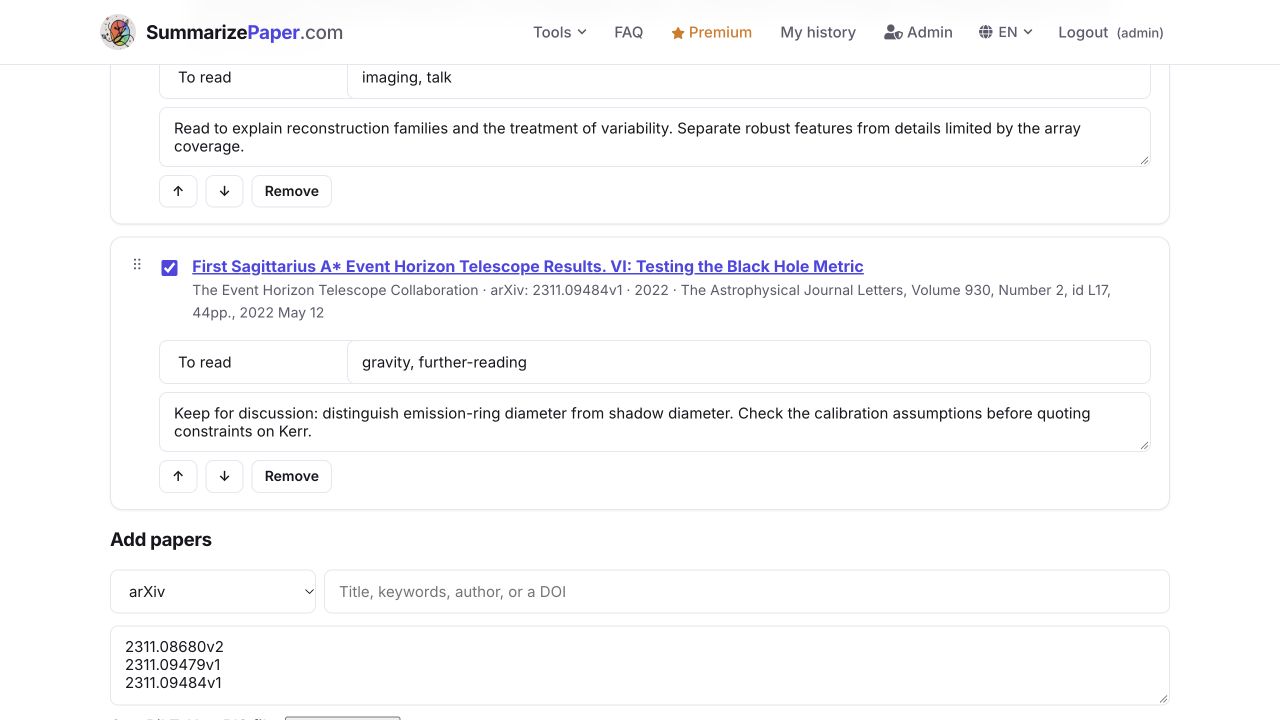
You can also save a paper from its page with “Save to a collection”. Importing a Zotero collection is another option with Premium; this demonstration uses the identifiers above.
Give every paper a purpose
In “Papers”, enter notes, tags and reading statuses. Changes save automatically; wait for “Saved” before leaving the page.
We marked Paper I as a “Key paper”, with the tags overview, talk. Its note already makes a decision for the presentation:
Open the talk with Figure 3: a robust ring, smaller images are not time frames. Do not present consistency with Kerr as proof of uniqueness.
Paper III is “To read”, tagged imaging, talk, to explain reconstruction families and variability treatment. Paper VI is “To read”, tagged gravity, further-reading, for the discussion of ring-to-shadow calibration.
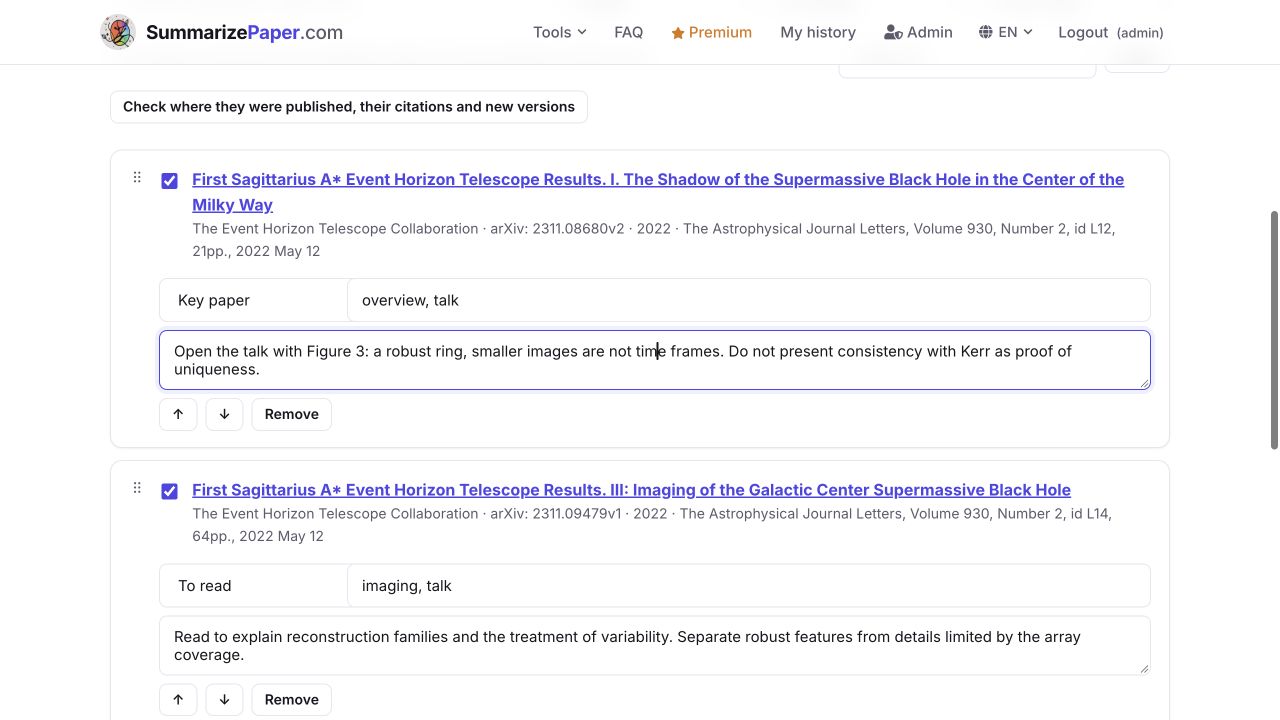
A note answers “why did I keep this paper?”. Use the arrows or drag the papers to arrange them in the order you want to read them.
Filter the view, then choose what the chat will read
Choose “talk” in the tag filter: only Papers I and III remain visible. Paper VI stays in the collection.
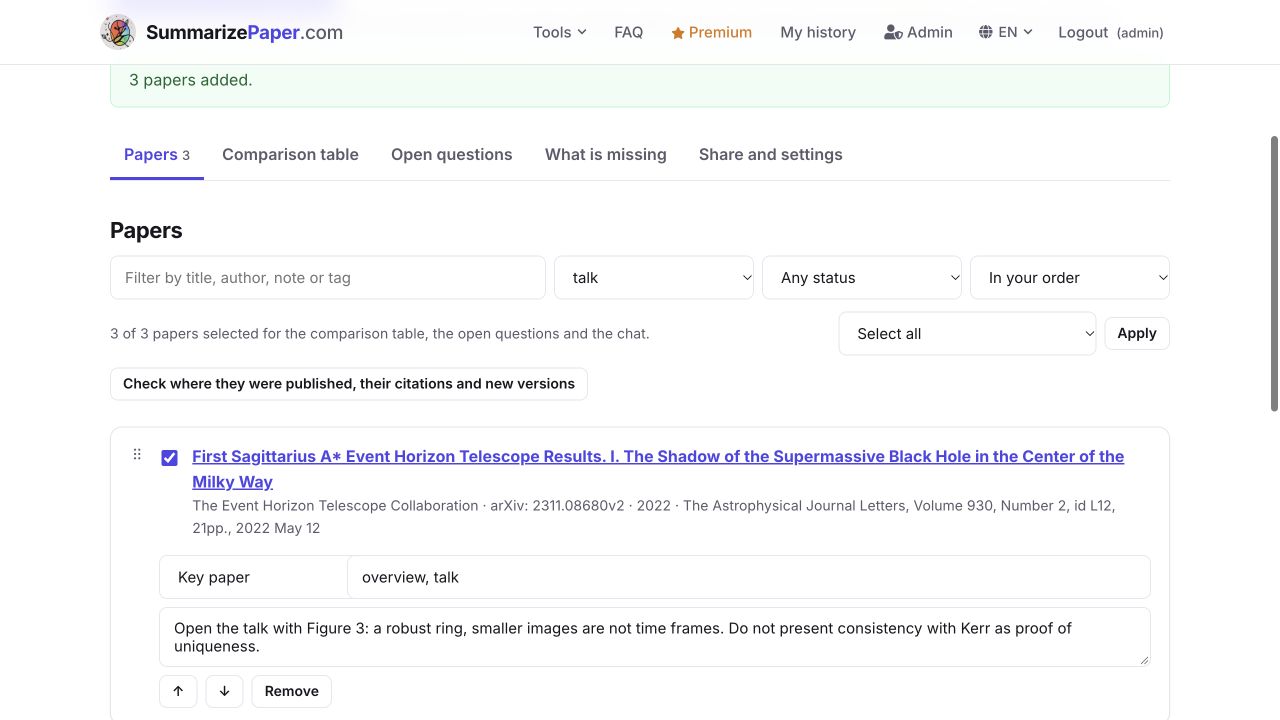
Filtering and selecting are separate actions. A filter does not deselect hidden papers. To restrict the analyses as well, choose “Only the tag ‘talk’” in the selection menu and click “Apply”. Check the counter: 2 of 3 papers selected. Checkboxes control which papers go to the chat, comparison and open questions; reading statuses organize your work.
Click “Chat with the selected papers”. In this demonstration, the chat opens with I and III only, both marked “Full text”.
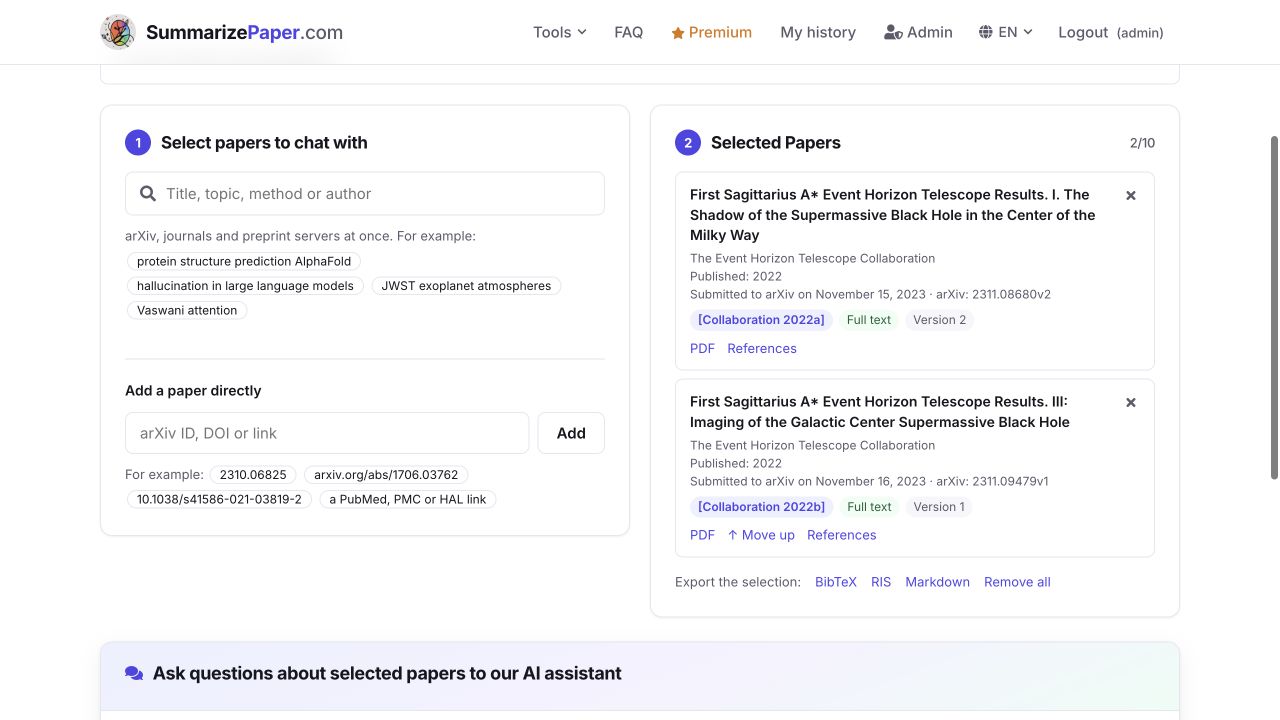
To ask about a figure and follow claims back to their sources, continue with the chat-with-papers guide. Return to the collection and apply “Select all” before the three-paper comparison below.
Build a table around your presentation
With Premium, open “Comparison table”, choose “Only my columns” and define your presentation criteria. Each line gives a label, then what to look for after the colon:
Contribution of the paper: this paper’s role in interpreting the image of Sagittarius A*
Result for the talk: one central result, with the quantity and its uncertainty if given
Limitation to mention: one limitation explicitly stated by the authors, without inventing one
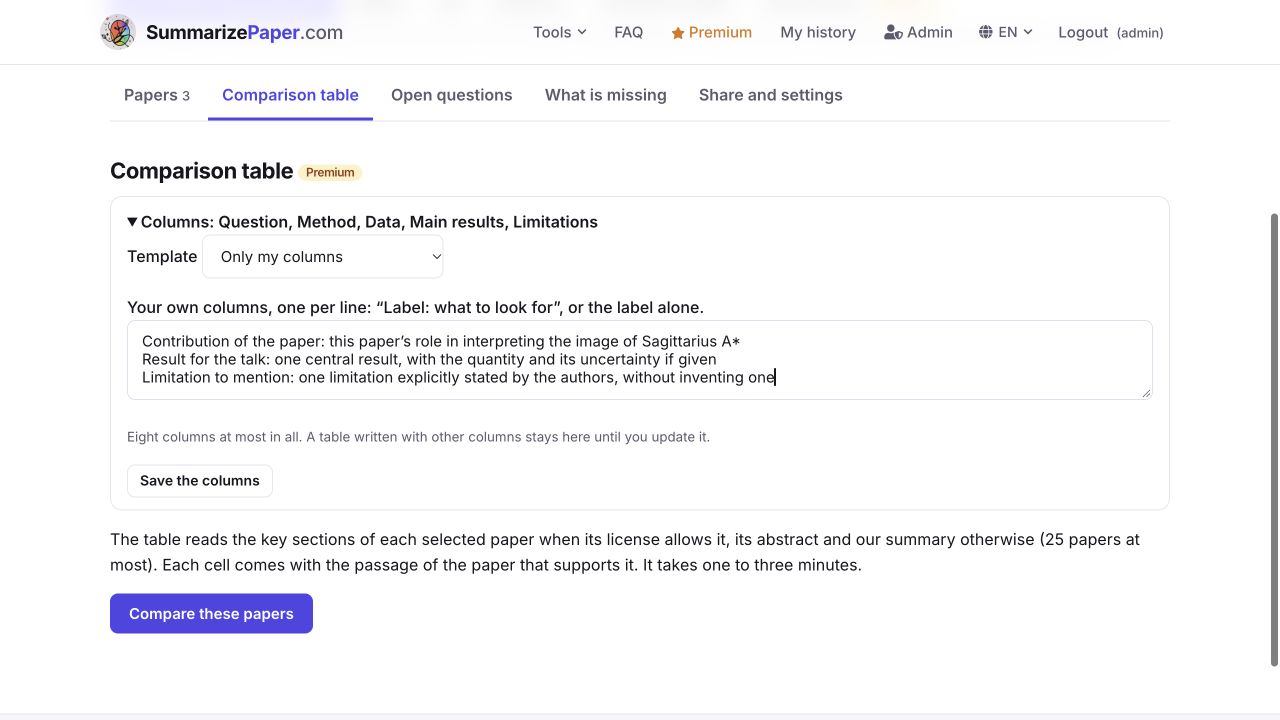
Click “Save the columns”, then “Compare these papers”. The English result separates the overview’s interpretation, the imaging paper’s reconstruction families and the metric paper’s testing framework.
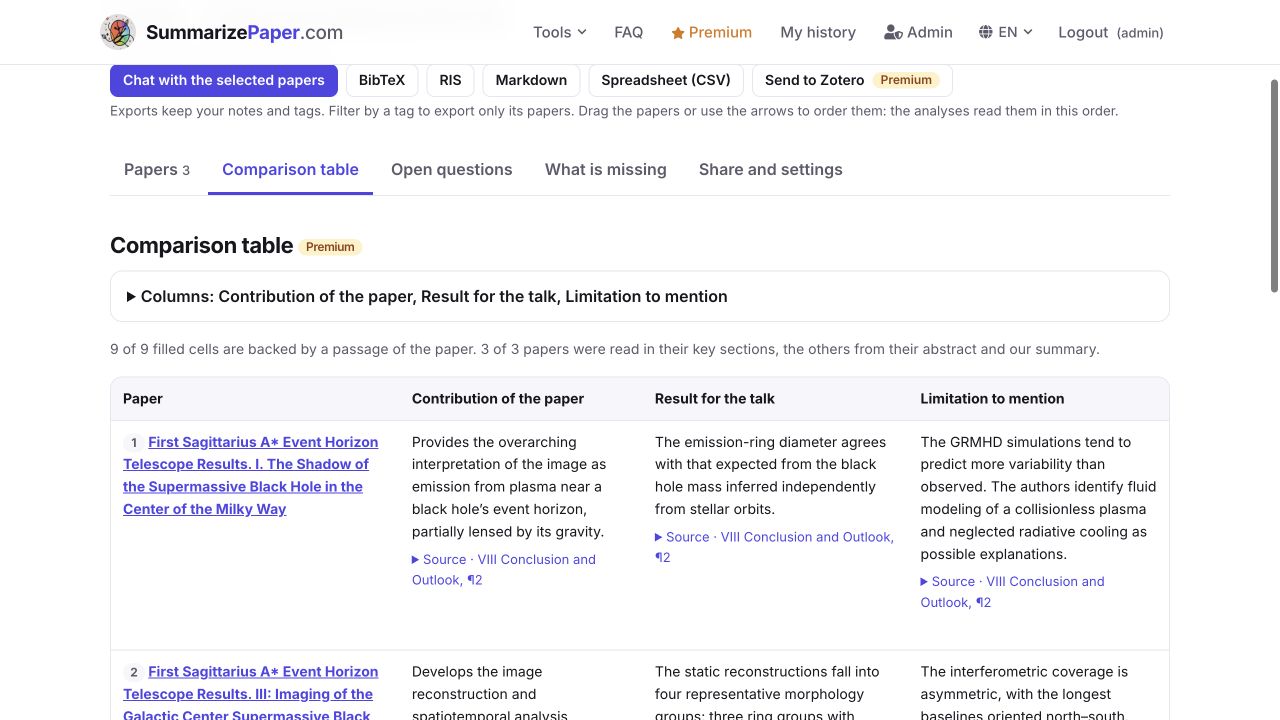
Available full text does not mean every analysis reads every word. The Collections table extracts key sections and also uses the abstract. Here, all three papers could be read beyond their abstracts; the displayed indicator confirms the scope. When the license does not permit that, the analysis uses the abstract and the available summary as context.
Open the source before quoting a conclusion
In Paper VI’s row, expand “Source” under “Limitation to mention”. The original passage explains that a quantitative calibration is required to connect the bright-ring diameter to the corresponding shadow diameter.
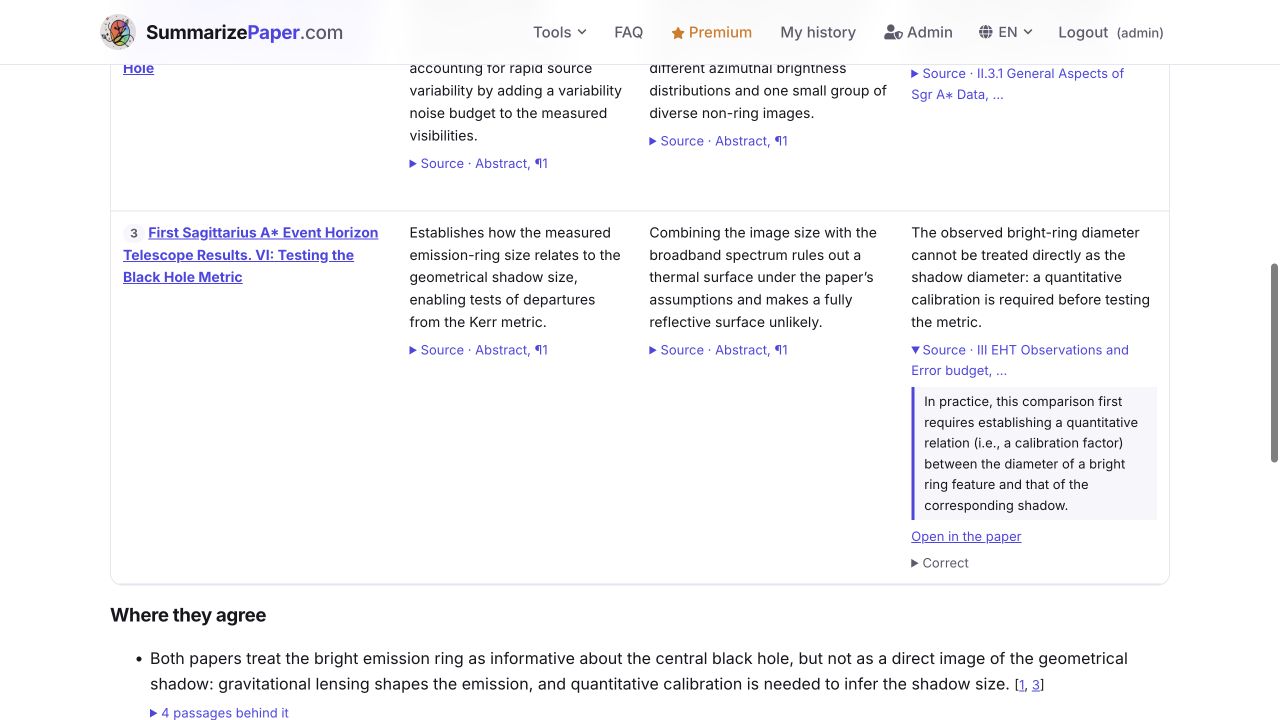
“Nine of nine” means passages were found, not that every interpretation is automatically correct. Check that the passage supports the wording and quantity in the cell. “Correct” lets you edit a cell; the change is labeled as a manual correction.
Below the table, agreements, differences and gaps point back to the rows used. Something missing from this small grid may still be covered in the full paper: read it before concluding that the authors did not study it.
Prepare the discussion questions
Under “Open questions”, run “Find the open questions”. The English analysis produced nine questions and three project ideas. They include the robustness of ring-to-shadow calibration and the challenge of recovering source dynamics with sparse observations.
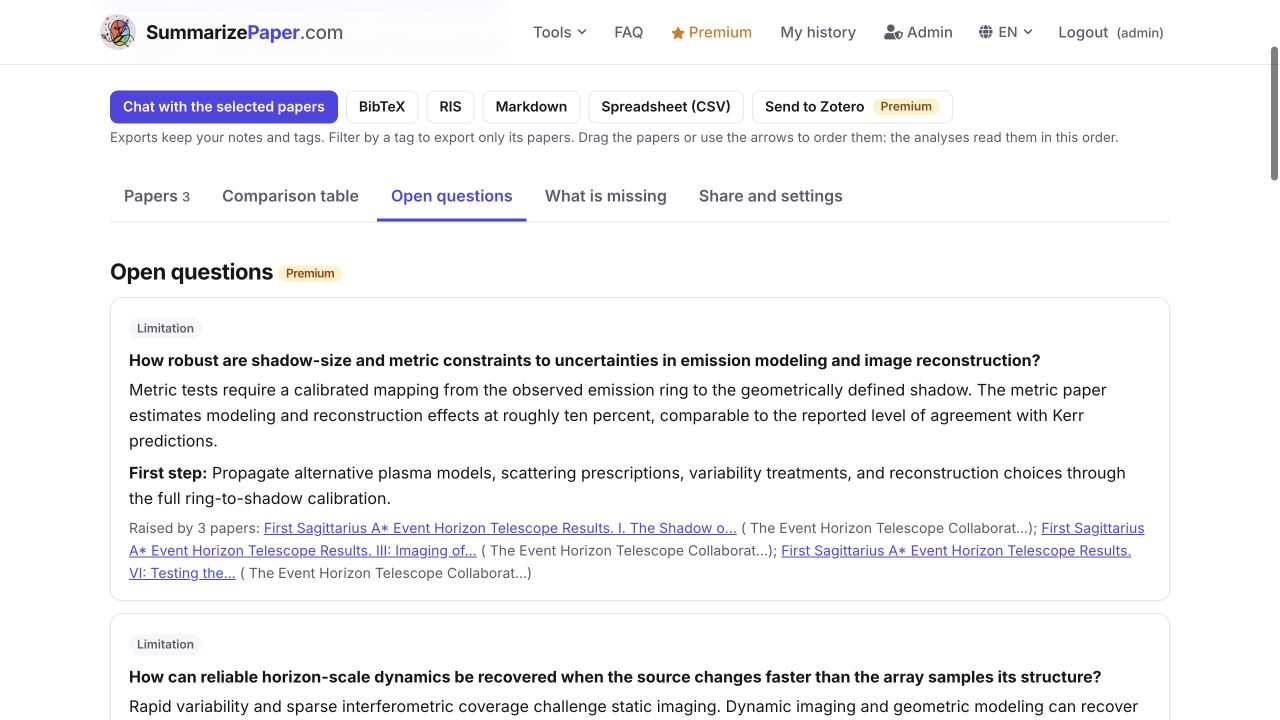
For a journal club, this gives you a useful closing question: which observations or synthetic-data tests would reduce the uncertainty? Suggested projects are starting points to assess. A question left open in these 2022 papers may have been addressed since: check later research before turning it into a research proposal.
Find a complementary reading, then take your notes with you
“What is missing” looks for references cited by several papers and for works close to the corpus. Here, the Ghez and colleagues study of stellar orbits appears as a reference cited by two collection papers.
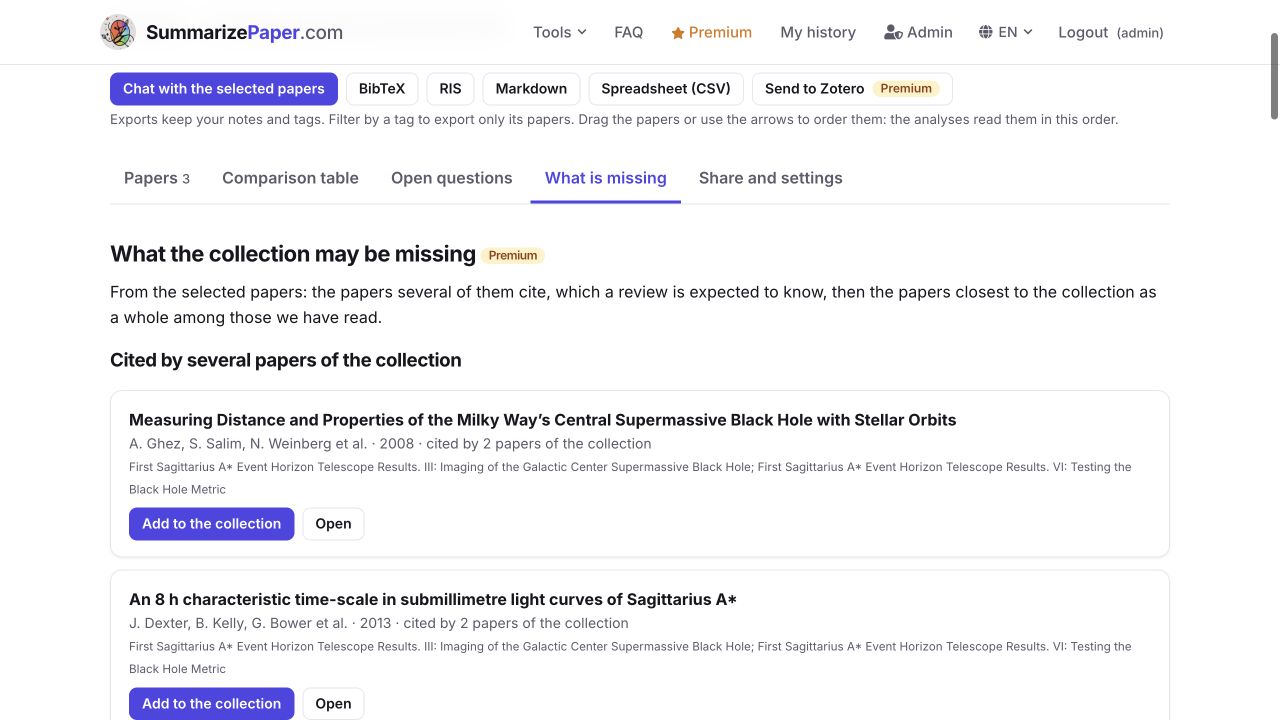
Suggestions help extend your reading; they do not certify a complete bibliography. Similarity results can concern a different object or method, so open the paper and decide how it contributes to your question.
Use Markdown for working notes, BibTeX for LaTeX, RIS for a reference manager or Spreadsheet (CSV) for the annotated list. The comparison table has its own CSV export. A tag filter lets you export just the papers carrying that tag; collection exports preserve notes and tags.
Collections with notes, tags and reading statuses are available with a free account. The comparison table, open questions and suggestions shown here require Premium. “Share and settings” also provides read-only sharing and collaborative editing. The demonstration collections remained private, with no invitation or email watch enabled.
Keep the papers, your reasons for reading them and your discussion questions together.
Prepare my collectionDemonstrations completed in English on 28 October 2026 using a Premium+ account. The three EHT papers are under CC BY 4.0. Screenshots show preparation notes written for this example and analyses actually obtained; scientific excerpts retain the papers’ original language.