
Chat with papers: from the Sagittarius A* image to the evidence
Below the Sagittarius A* image sit four smaller images that look similar but not identical. Are they successive moments in time, or different ways to reconstruct the same observations? That is a specific question to ask Chat with papers, then check against the source. This walkthrough starts with a figure, turns the answer into a journal-club explanation and brings in a second paper to examine what the image can establish about gravity.
The examples use two EHT collaboration publications from 2022: Paper I, presenting the image and overall findings, and Paper VI, examining tests of the black hole metric. We use arXiv versions 2311.08680v2 and 2311.09484v1. Both are licensed CC BY 4.0, and both were actually read in full during these demonstrations.
Start with a paper whose full text is available
Already on a paper’s page? Ask your question in its chat box: the paper is already selected. The steps in this guide about figures, source passages and follow-up questions also apply there. The screenshots show the Chat page; comparing several papers and building tables require that page.
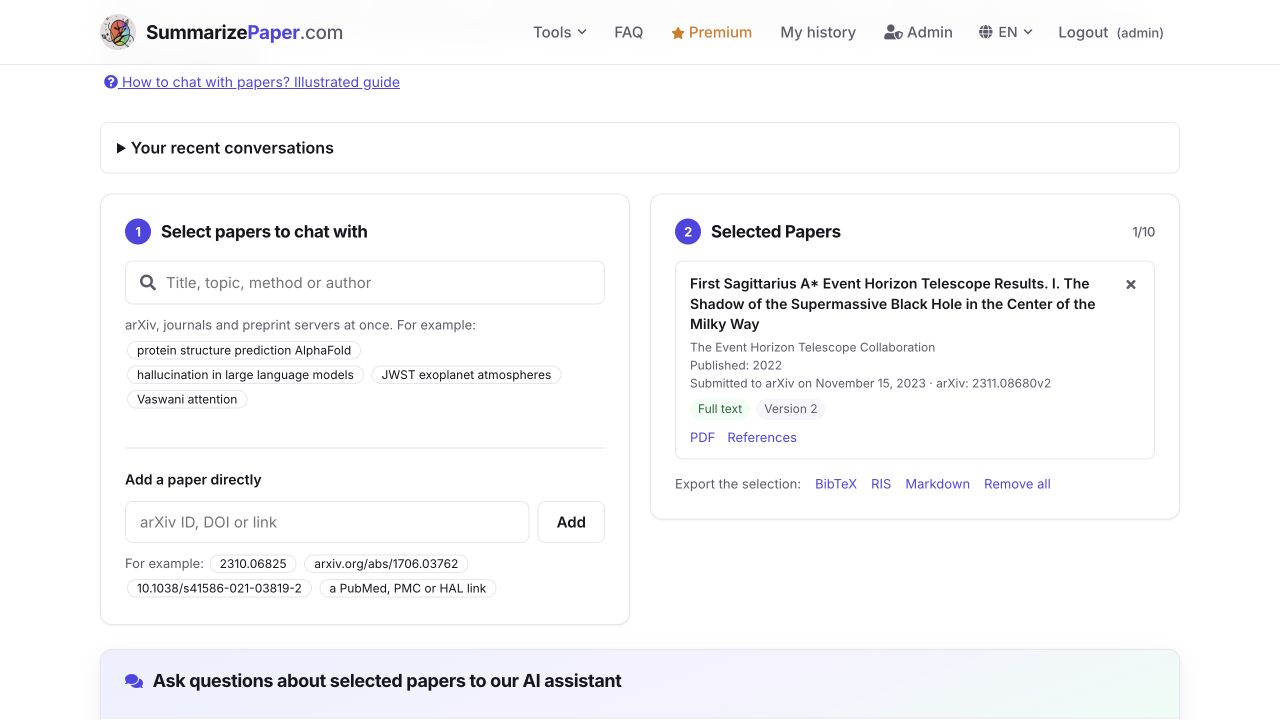
Open the chat with Paper I. Alternatively, paste 2311.08680v2 into “Add a paper directly” and click “Add”. A DOI or a paper link also works.
Wait for “Full text” on the selected paper’s card before sending your question. Its version appears alongside it, so you can identify the same source later. When only an abstract is available, that limitation is indicated in the same place; this example uses the full text.
Ask about the figure, rather than requesting a general summary
Open “Figures and plots”, locate Figure 3 and click “Ask about this figure”. The button prepares a reference to the figure and paper; complete it with what you want to understand. We ran this question for the guide:
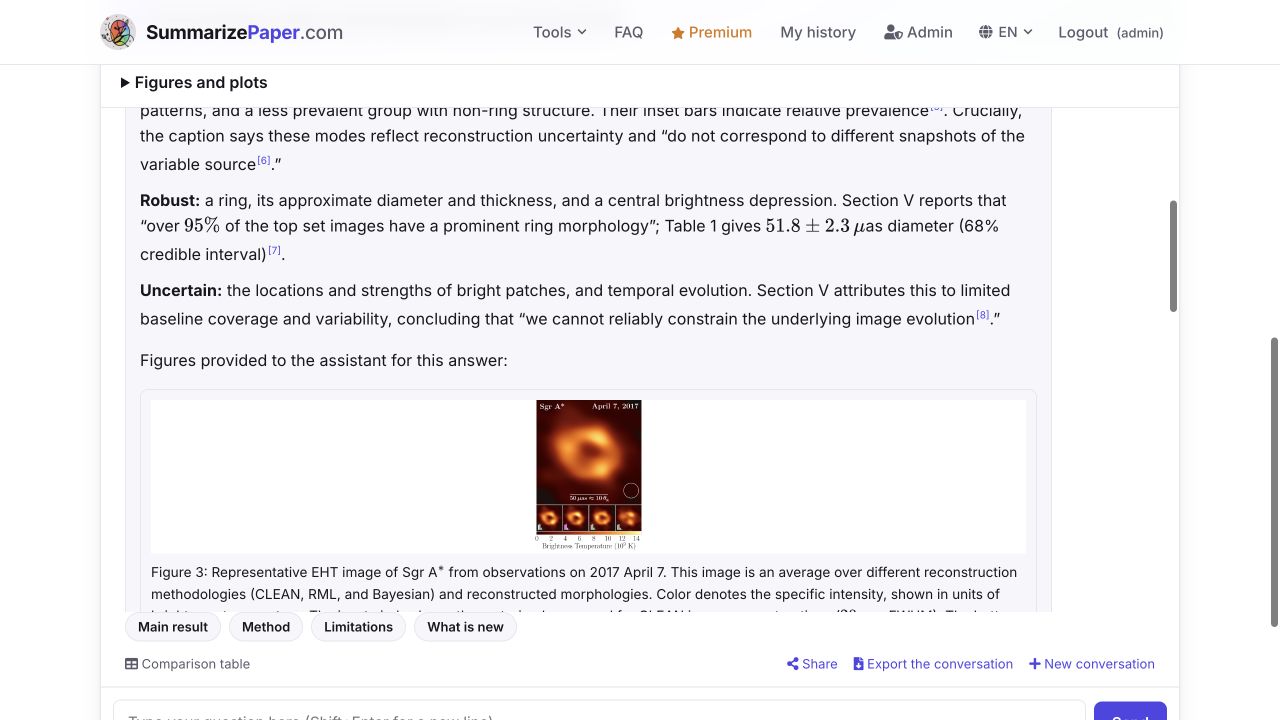
Visually analyze Figure 3 of paper 2311.08680v2. In at most 200 words, explain the large ring and the smaller images below it, then distinguish robust features from remaining uncertainties. State whether you actually received the image and support scientific conclusions with passages from the paper.
The answer identifies the smaller panels as averages of reconstruction groups, rather than successive frames in a movie. It separates the ring and dim center from less certain brightness details. The “Figures supplied to the assistant for this answer” block, visible in the opening screenshot, identifies the image actually used.
A visual observation, a measurement reported in the paper and a physical interpretation require different evidence. The answer’s source checks let you inspect those distinctions.
Follow a claim to its source
In the English answer, click [6], after the explanation that the smaller panels are not snapshots at different times. The chat takes you to the original caption, which states that distinction. The source is a passage you can read, rather than simply a bibliography entry.
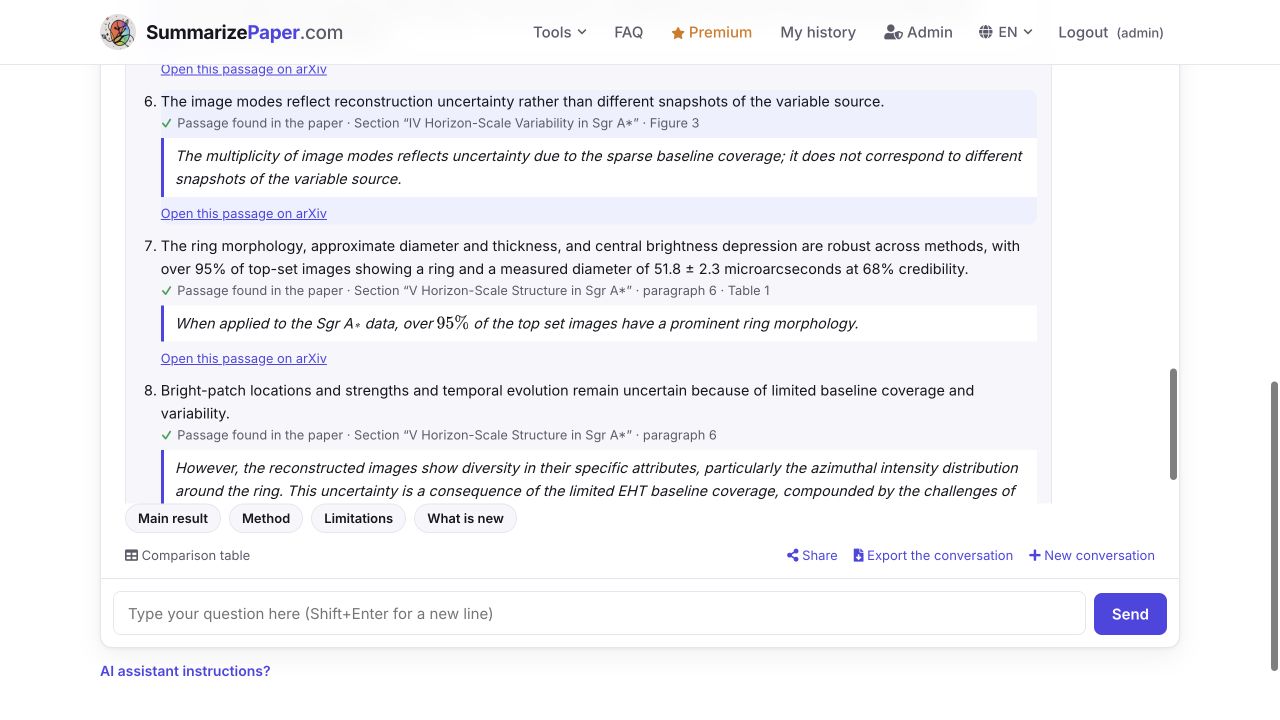
The English answer reports 5 of 8 claims found word for word in the paper. The other three are marked as readings of the figure image. This count describes provenance, rather than serving as a scientific correctness score. Open the claims that matter to your argument and examine their context.
Follow up with an explanation for your audience
Ask for a formulation suited to your task. To keep the exchange on the intended image, repeat the figure number and paper: a vague follow-up about “this figure” can lead the answer toward other illustrations.
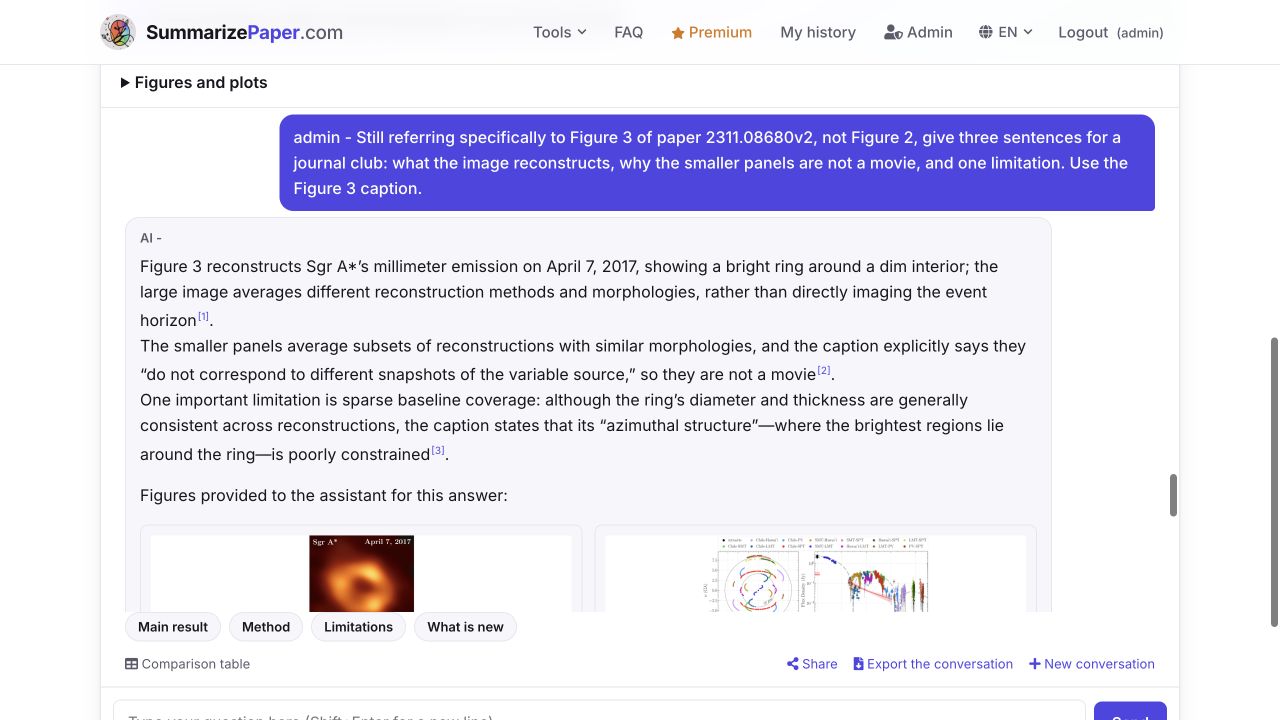
Still referring specifically to Figure 3 of paper 2311.08680v2, not Figure 2, give three sentences for a journal club: what the image reconstructs, why the smaller panels are not a movie, and one limitation. Use the Figure 3 caption.
The result is a three-sentence explanation that retains a concrete limitation: sparse baseline coverage leaves the brightness distribution around the ring poorly constrained. You have a short explanation to work with, alongside its sources.
Bring two papers into the conversation
Open a comparison with Papers I and VI, or add 2311.09484v1 to your selection. Both cards show “Full text” here. The [Collaboration 2022a] and [Collaboration 2022b] tags distinguish the texts; 2022 is their journal publication year. The November 2023 arXiv submission dates are labeled separately on the cards. When no publication year is known, the chat falls back to the deposit year.
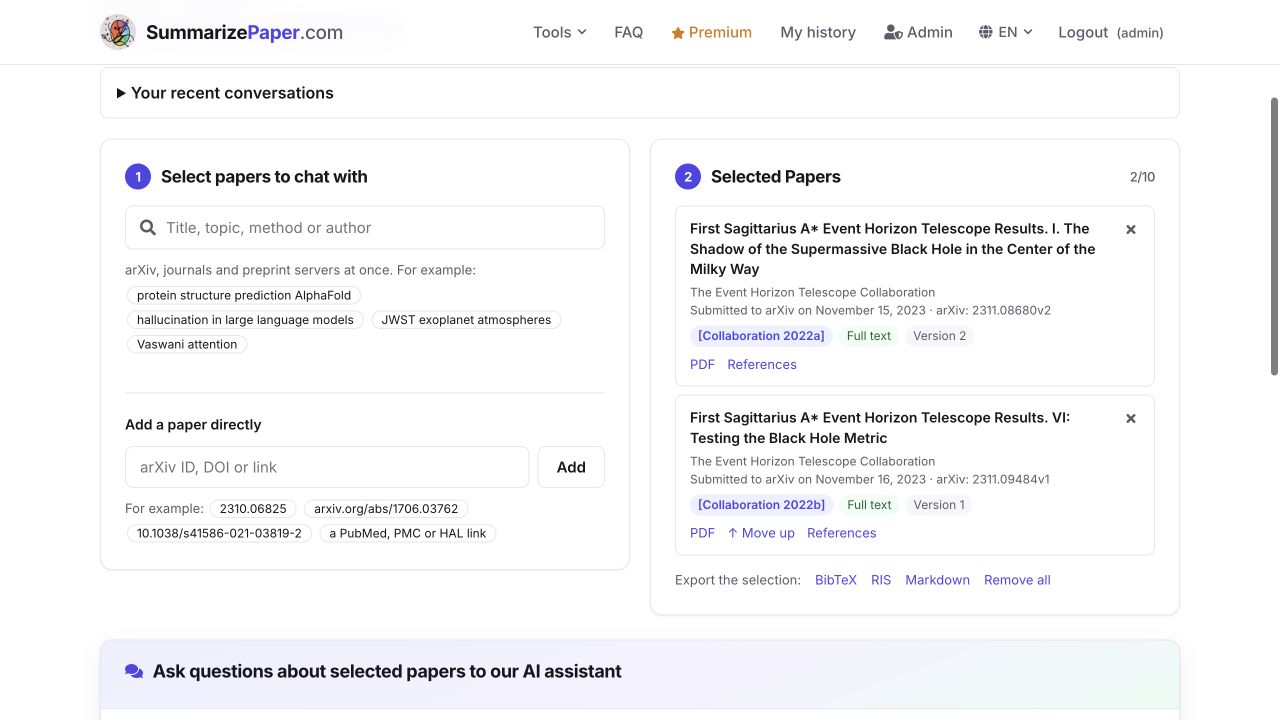
Ask a comparison question that gives each paper a specific role:
Compare papers I (2311.08680v2) and VI (2311.09484v1) in at most 180 words: what does the first measure, what does the second calibrate and test, and why is “the image looks like a ring” insufficient to conclude that all alternatives to Kerr are excluded? Attribute each conclusion to the right paper and cite supporting passages.
The answer distinguishes the emission-ring size studied in Paper I from the shadow inference and geometric tests developed in Paper VI. It attributes each part to its paper and points to supporting passages.
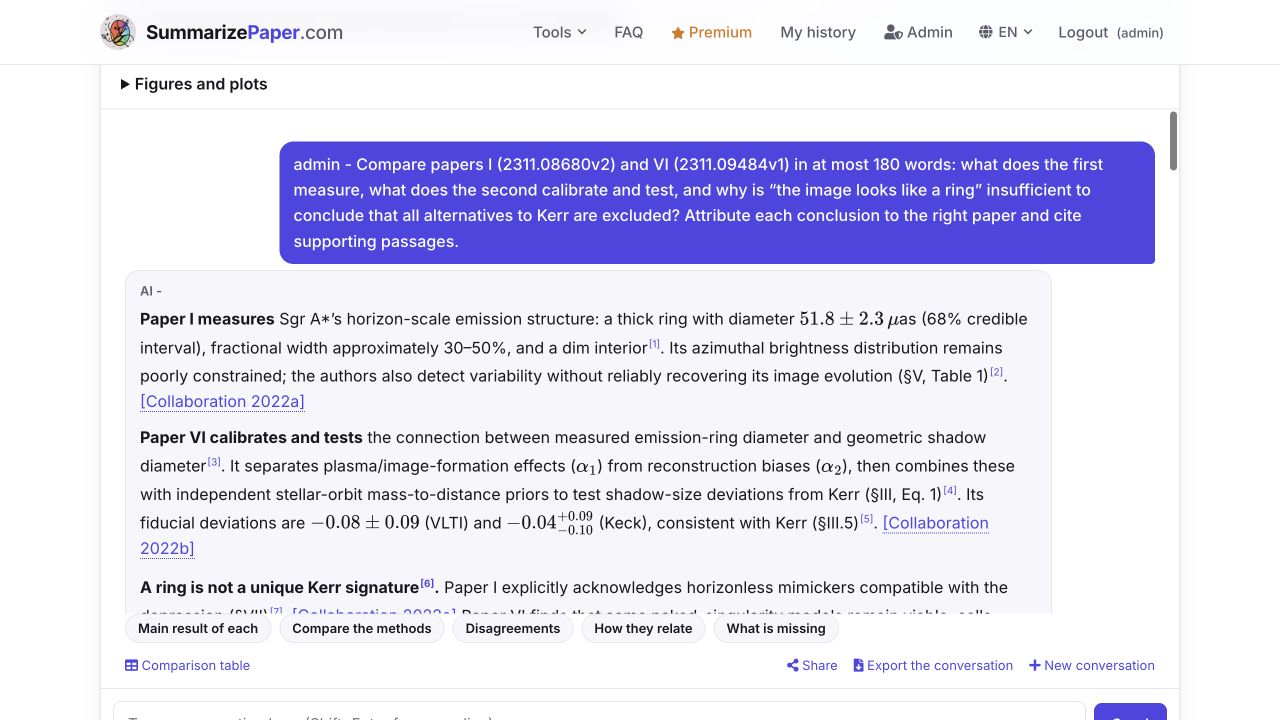
These publications analyze the same observing campaign. Comparing them clarifies their contributions; it does not turn them into independent experiments. Likewise, different reported numbers need not disagree if one describes a bright emission ring and another a geometric shadow.
Build a table around the quantities you need
With Premium, click “Comparison table” and replace the default columns with your criteria, one per line. For this case, we chose:
Role of the paper in the analysis of Sagittarius A*
Ring or shadow size and definition of the quantity
Scope and limitations of the Kerr test
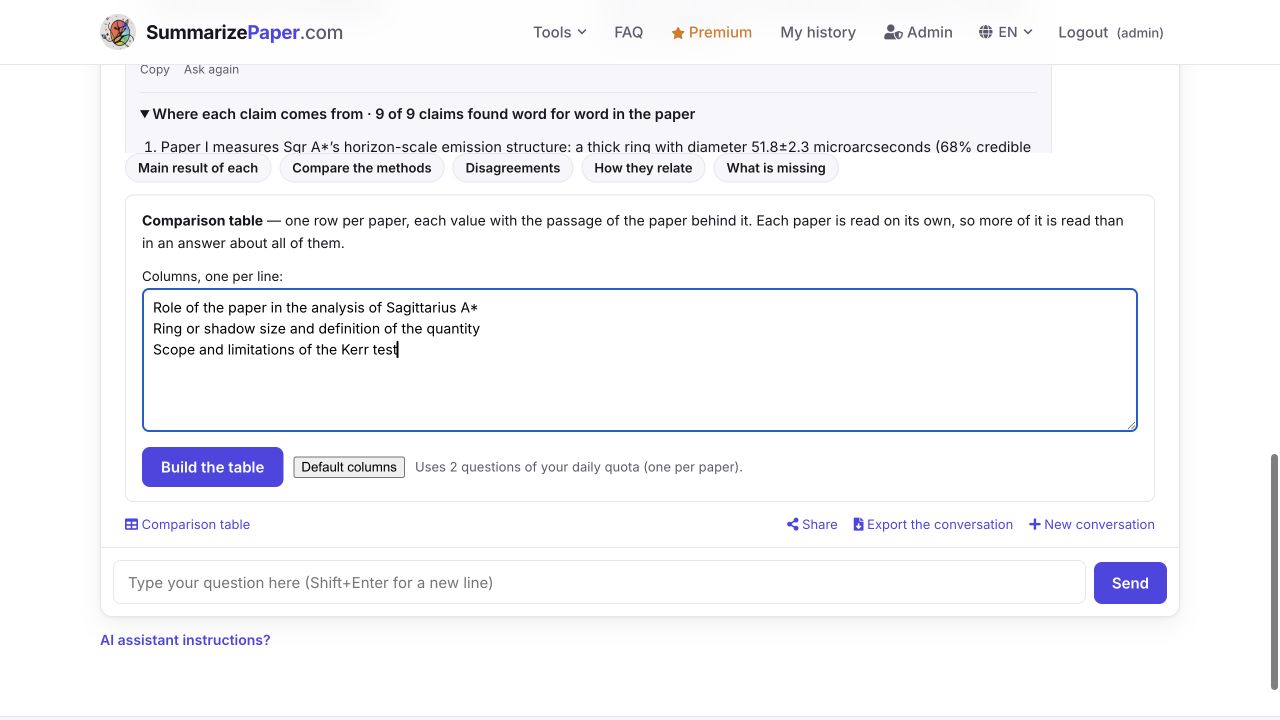
Click “Build the table”. The two resulting rows organize the papers’ roles, reported quantities and limitations. All six filled cells in this example have a supporting passage found in their source text.
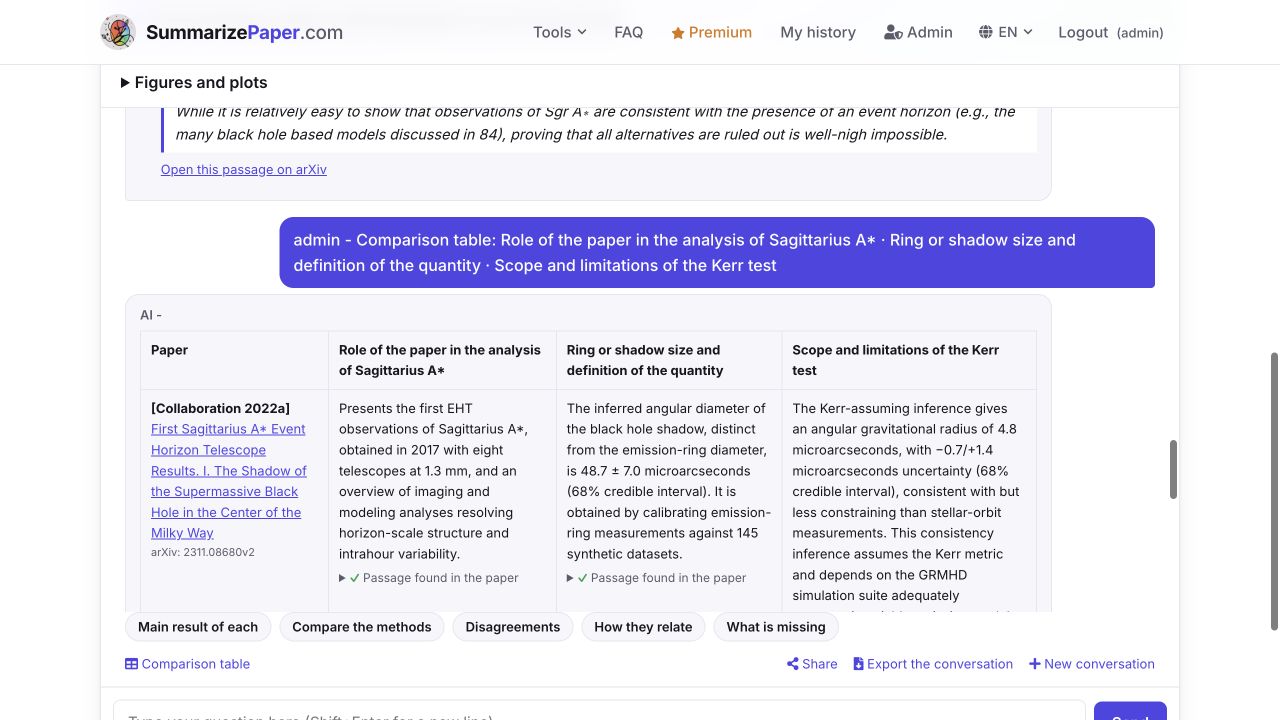
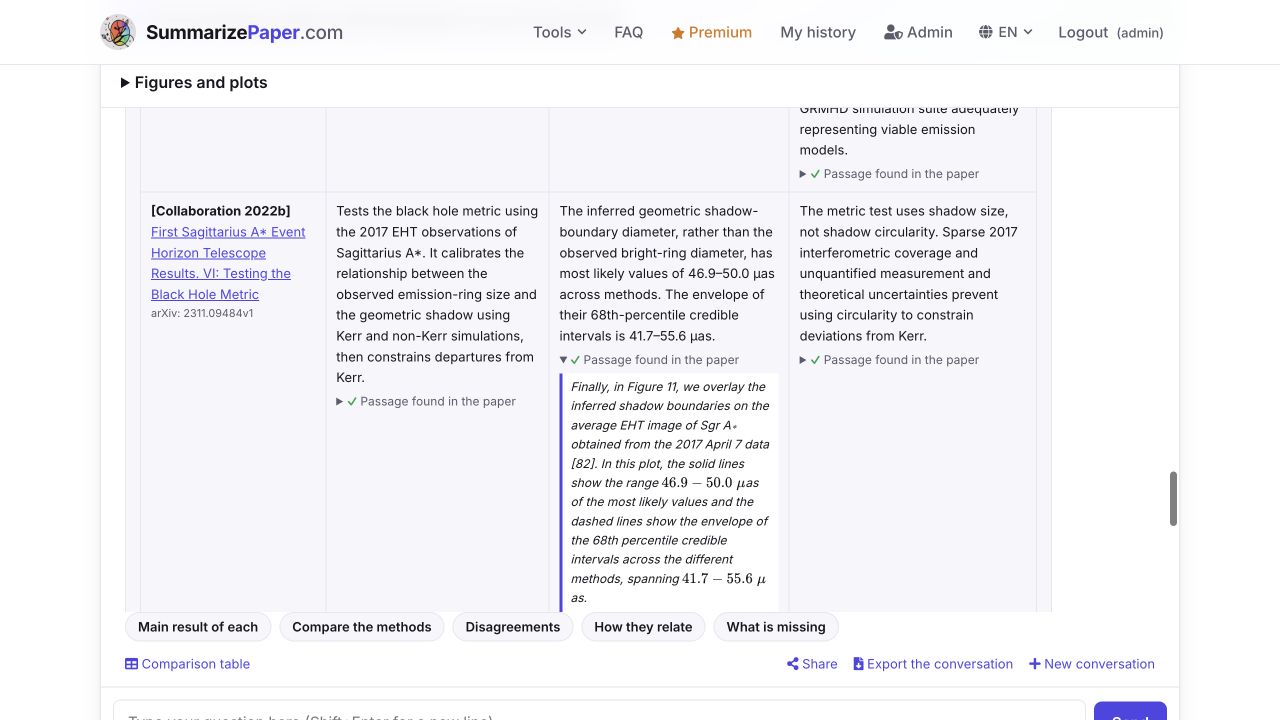
Expand a cell’s supporting passage. Below, the Paper VI row lets you inspect the source accompanying its inferred shadow sizes. The table becomes a way back into the papers, keeping values connected to their definitions.
Keep a discussion you can check later
Under an answer, “Copy” includes the text and its sources. “Export the conversation” preserves questions, answers and associated passages. The table also provides CSV and Markdown exports. Treat the export as working notes and open the original sources before using a conclusion in scientific writing.
To repeat this workflow, start with one figure and a specific question. Add a complementary paper when the question calls for comparison. If you want to orient yourself first, the summaries guide shows how to read the paper’s essentials and limitations.
From the Sagittarius A* image to tests of gravity: ask your own questions of both papers.
Chat with both papersDemonstrations executed in English on 28 October 2026 using a Premium+ account. Both papers were read in full; Figure 3 was actually supplied for visual analysis. Conversations remain private: the guide links only open the selected papers. Figure shown in the screenshots: EHT collaboration et al. (2022), Paper I, under CC BY 4.0, displayed at reduced size in the interface.