
Citation alerts: follow a paper and see how others use it
Your paper has been cited. Which result was used, and what did the citing authors do with it? Citation alerts take you from a count to the sentence behind a reference. With Premium, you can follow your own publications, a key paper in your field or a team’s work.
This walkthrough follows Kral et al. (2017), Predictions for the secondary CO, C and O gas content of debris discs from the destruction of volatile-rich planetesimals, arXiv:1703.10693. Our question is specific: how do subsequent studies use this model of gas released by planetesimals? We will set up a watch, inspect citation evidence and turn a useful result into a reading task.
1. Start by following one paper
Sign in to your Premium account and open Citation alerts. Under Papers to follow, search by title or paste 1703.10693 into the identifiers field. DOIs and links also work; separate multiple references with spaces or new lines. Click Follow.
Tick These are my papers only when you are an author. Leave it unticked when following somebody else’s reference. You can also start from Tell me who cites it in the advanced tools on a paper page.
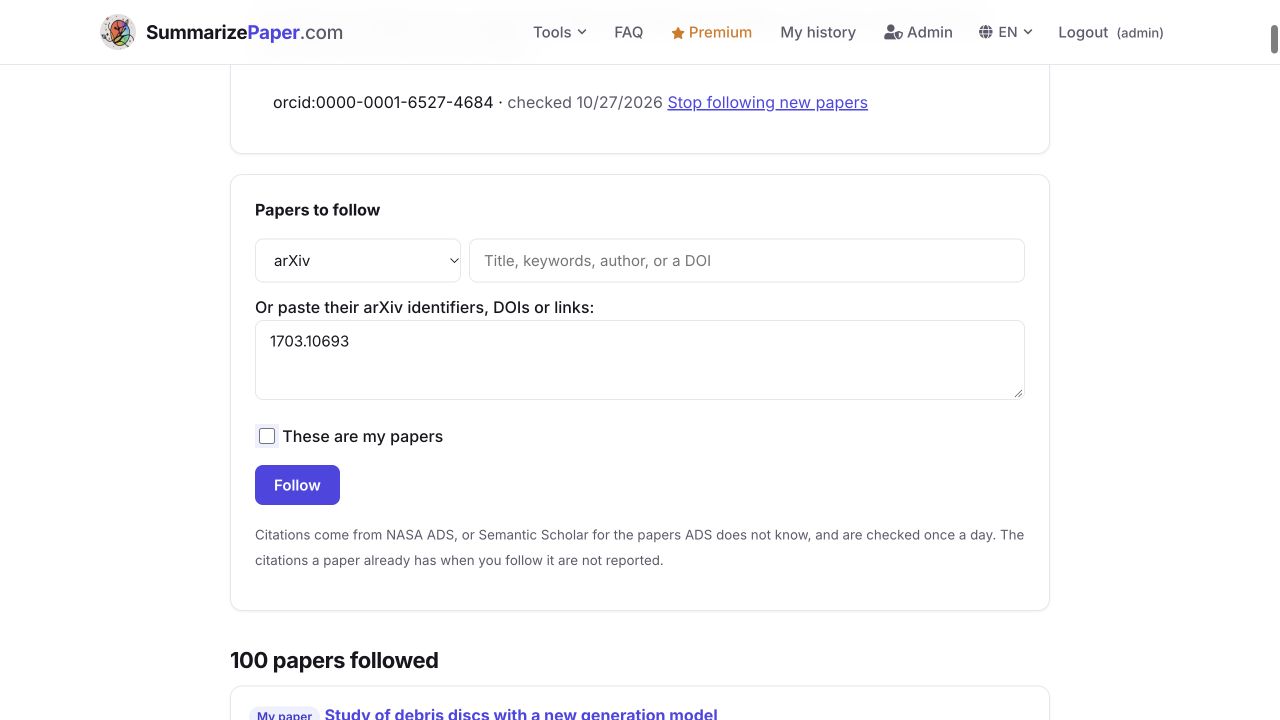
Find the title in your followed list and choose See its citations. The first check may take a little time. Citations already present when you begin following form the browsable baseline; they do not all generate a catch-up email.
Import your own publications together
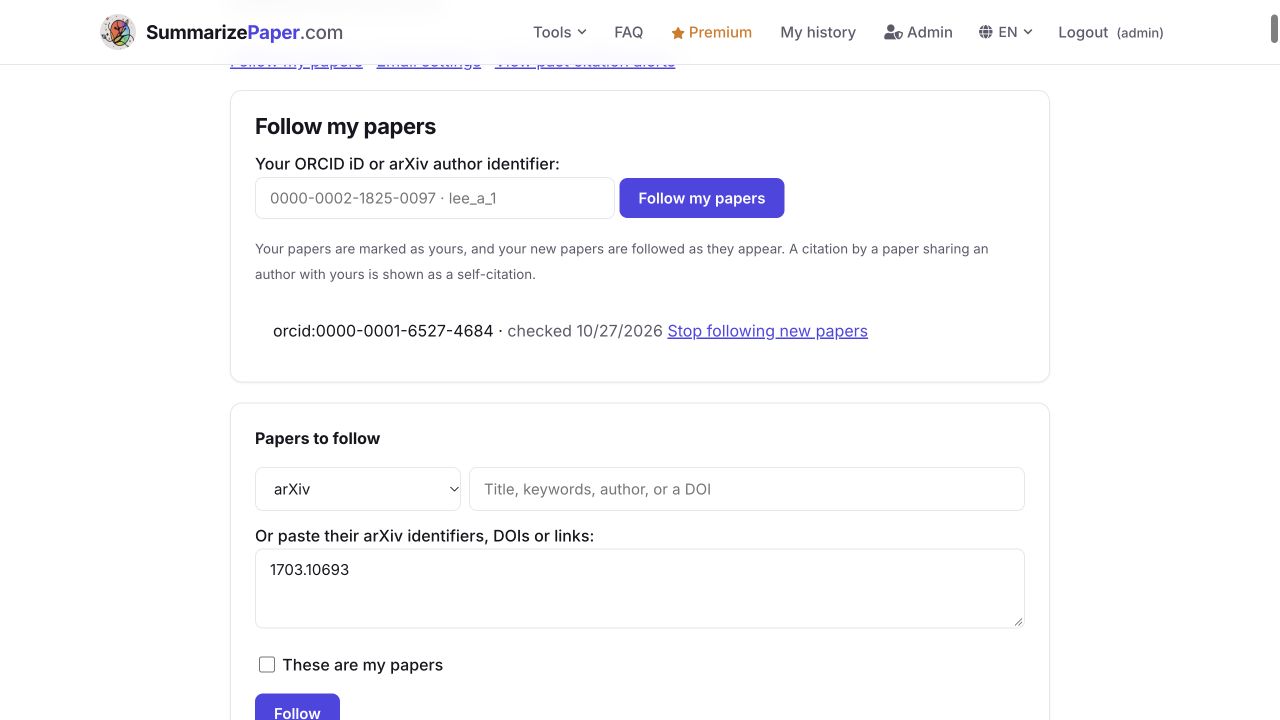
For your own research output, use Follow my papers: enter your ORCID iD or arXiv author identifier, then click the matching button. Found papers are marked as yours, and new publications are followed as they appear, up to the limit shown by the tool. Check the imported list, especially where journal and preprint records appear separately.
2. Choose the email schedule
Open Email settings, choose every day, every week or every month, then click Save. The separate immediate-email option applies when a newly found paper clearly questions a followed reference.
The sources are checked once a day. An immediate alert means notification after detection and analysis; it is not continuous monitoring of publishers’ websites. If alerts are bundled into a digest, read the notice in your settings: bundling can determine the delivery schedule.
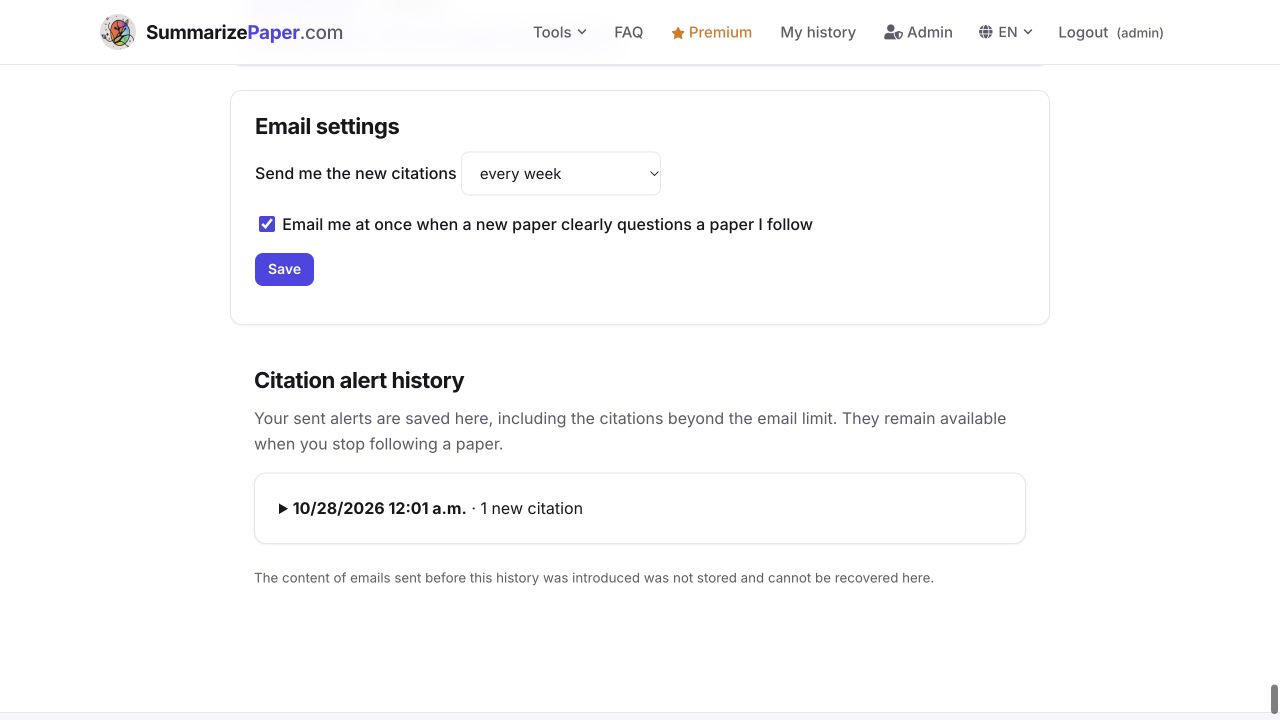
Use View past citation alerts to open a dated entry and its Citation excerpts. The archive retains sent alerts, including references beyond the email limit, even after you stop following a paper. A newly detected citation can come from an older paper, so the alert date and publication date need not match.
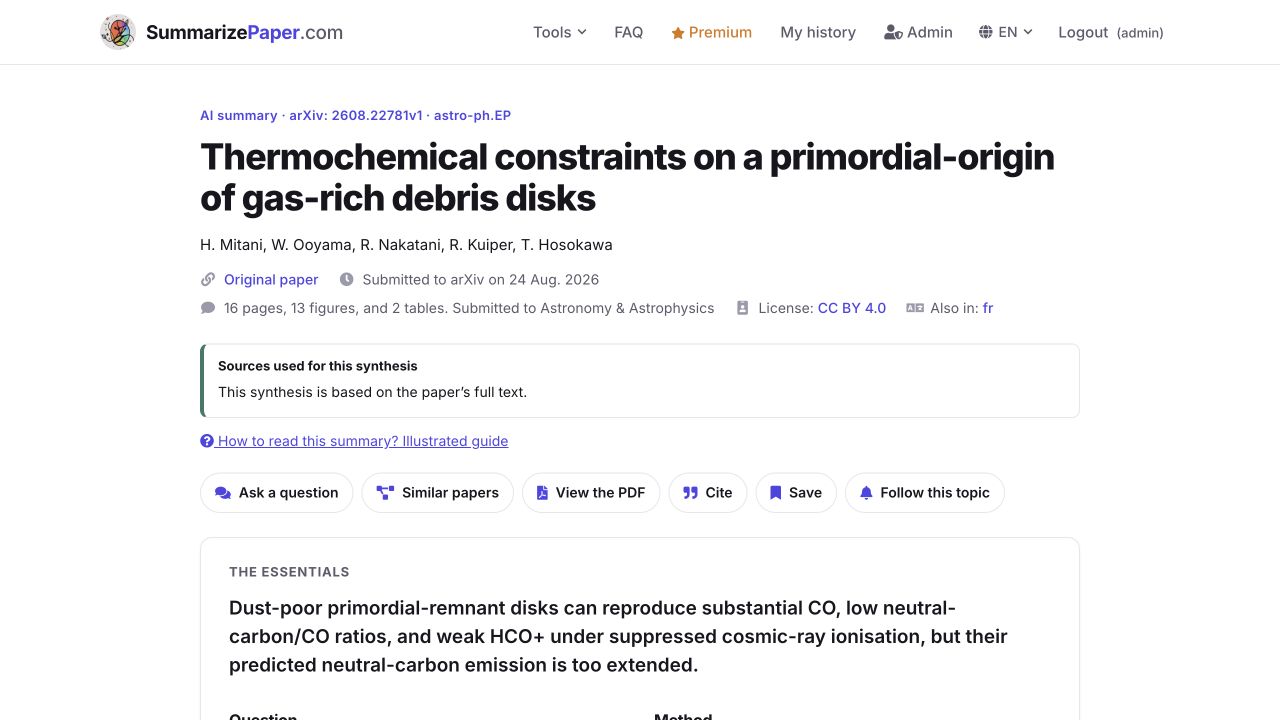
For example, the archived alert dated 28 October 2026 points to Mitani et al., Thermochemical constraints on a primordial-origin of gas-rich debris disks, submitted to arXiv on 24 August 2026. Its citation recalls neutral carbon as a product of CO photodissociation in a secondary-origin model. The live citation page labels this passage mentions it: the label describes the use of this particular reference, rather than the overall scientific position of the citing paper.
3. Read the coverage behind the headline count
At our 28 October 2026 visit, the Kral et al. page has 136 citations, 74 with a citation sentence, 61 judged, and 58 marked as self-citations. The judged breakdown is 2 questions, 3 supports, 2 builds on, 18 uses and 36 mentions. These numbers will change as the sources and analyses evolve.
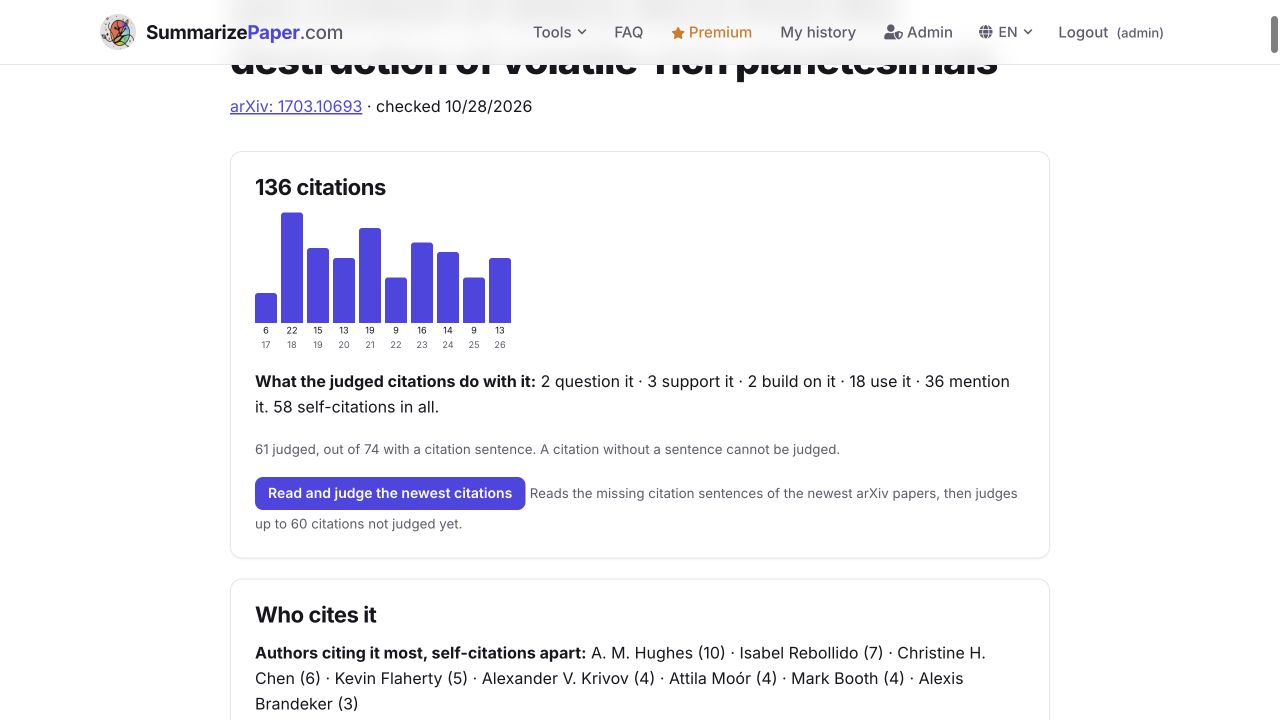
Click a year in the chart to inspect that period. Who cites it lists frequent citing authors with self-citations excluded. Here a self-citation means that the citing and followed papers share at least one author; it does not establish whether the contribution is scientifically important.
Read and judge the newest citations looks for missing citation sentences in recent arXiv versions, then analyses up to 60 citations still needing work. Let the task finish and reload the page. Classification uses the available excerpts; it does not replace reading the whole study.
4. Find a concrete reuse of a modelling assumption
Set Verdict to uses it, Self-citations to Hidden and Year to 2026, then click Filter. The example returns two citations: a manageable reading list instead of 136 titles.
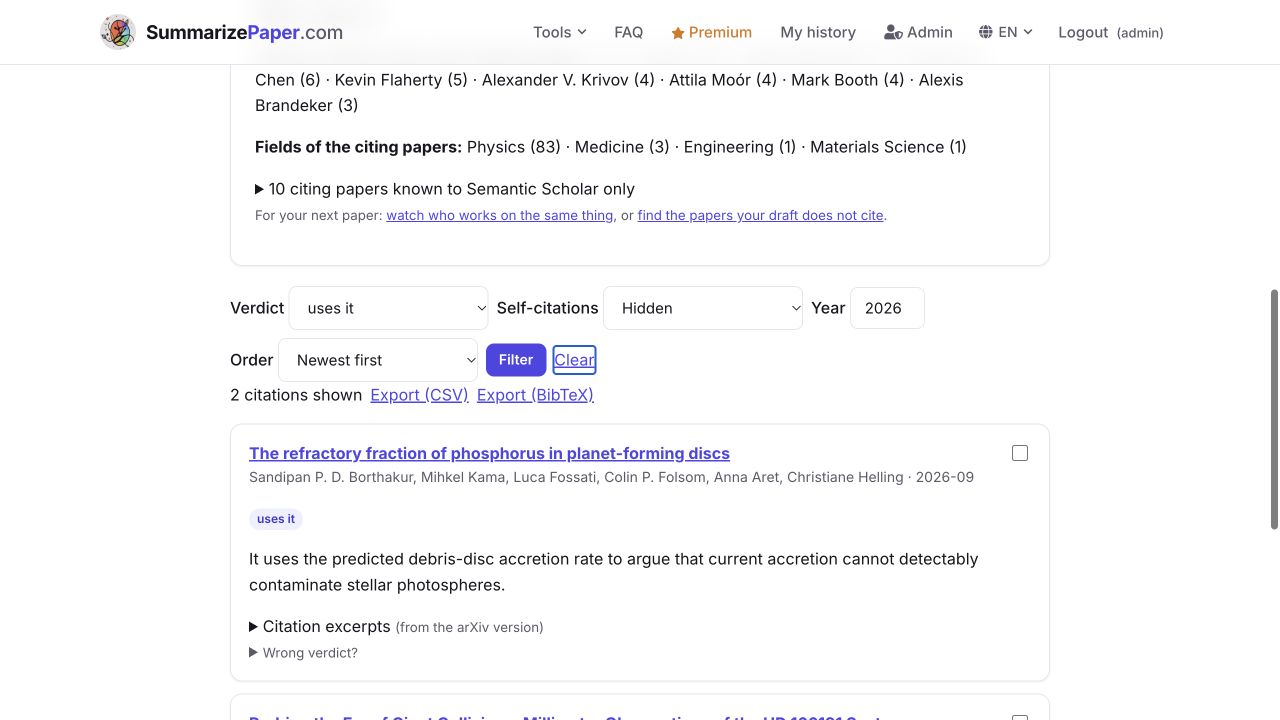
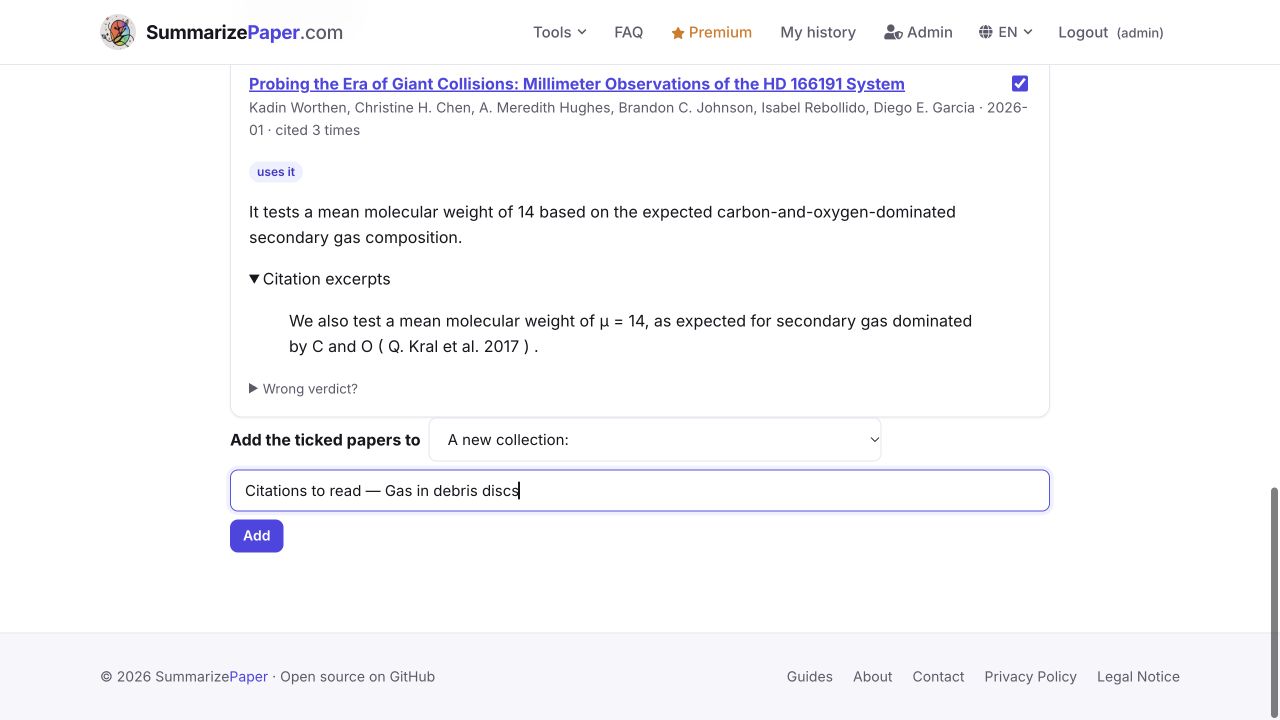
Expand Citation excerpts under Worthen et al., Probing the Era of Giant Collisions: Millimeter Observations of the HD 166191 System. The sentence says that the authors test a mean molecular weight μ = 14, expected for secondary gas dominated by carbon and oxygen, citing Kral et al. (2017).
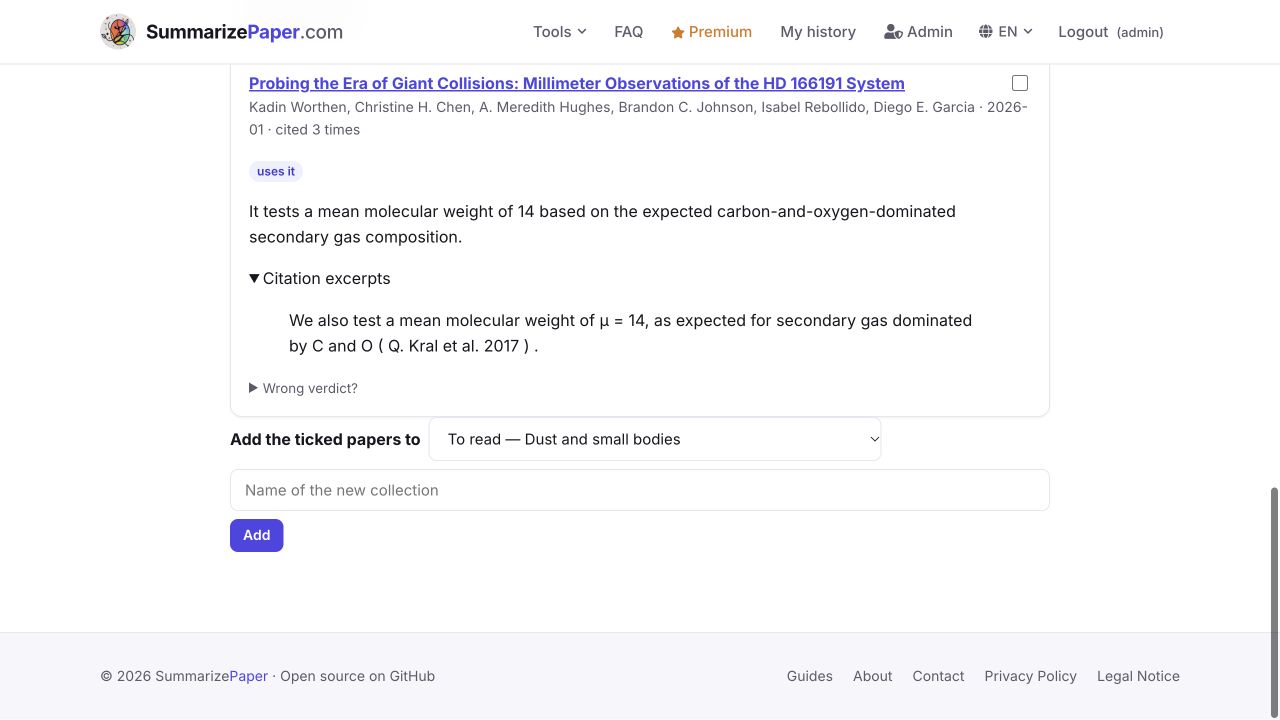
This gives you a precise reason to read the study: see how a gas-composition assumption enters the interpretation of HD 166191 observations. Reusing one assumption does not establish that the study confirms every part of the 2017 model.
5. Inspect a possible challenge with its uncertainty intact
Select questions it, clear the year and show self-citations. Two results appear, both marked uncertain. In Hales et al. (2022), ALMA Observations of the HD 110058 Debris Disk, the excerpt reports a CO mass more than two orders of magnitude above the cited estimate, even at the lower end of the 95% confidence interval.
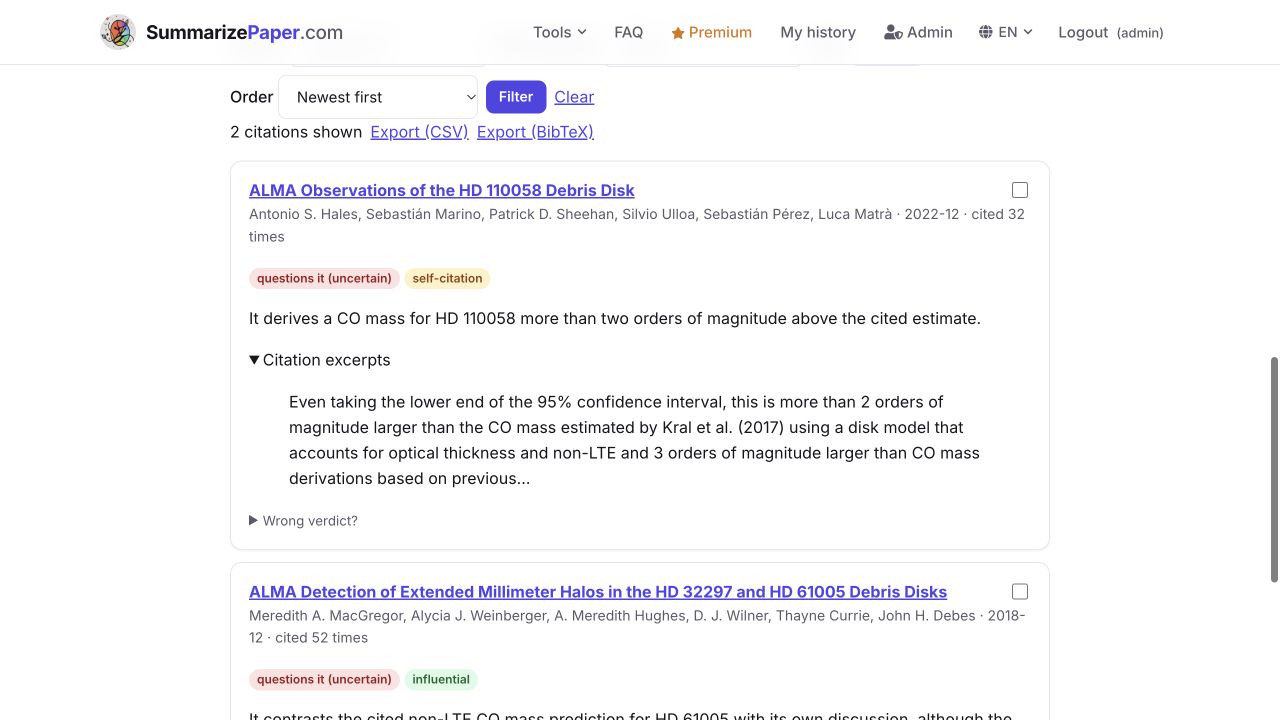
That discrepancy is a reason to compare assumptions and data. A mismatch for one system does not automatically refute the entire secondary-origin scenario. Keep the uncertainty label in your interpretation. If you open Wrong verdict?, read the scope shown before submitting: for a paper marked as yours, an author’s correction may apply to all its followers.
6. Know when there is no verdict to interpret
Choose Not judged, hide self-citations and set the year to 2025. Here, two papers have no citation sentence available. An absent verdict is neither support nor criticism. Open the paper and its PDF to inspect the reference yourself.
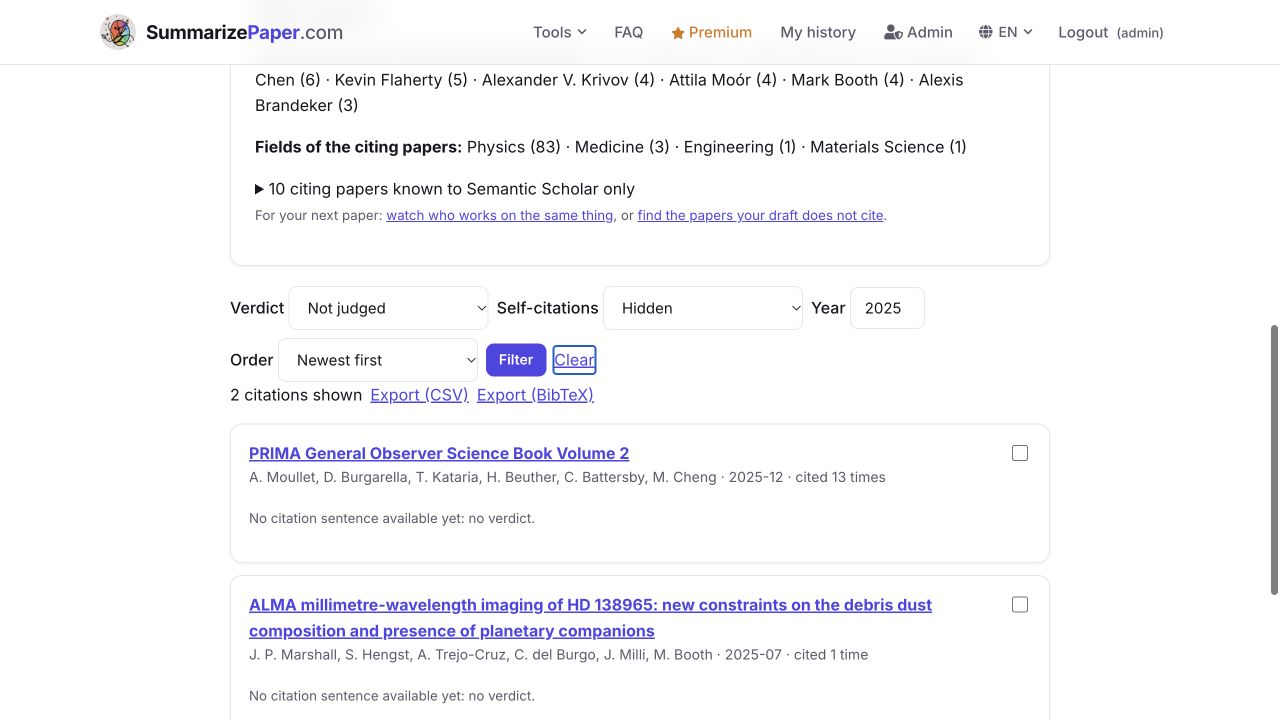
Citations come from NASA ADS, or Semantic Scholar for papers ADS does not know. Coverage, separate version records and indexing delays affect the results. The count should not be treated as an exhaustive inventory of every use of your work.
7. Continue into the full text and its figures
Open the arXiv paper page for Mitani et al., the study in the example alert. This synthesis is based on the paper’s full text. confirms that the reading goes beyond its abstract. The CC BY 4.0 licence and arXiv submission date appear above the summary. This is a preprint submitted to a journal, rather than an announced journal acceptance.
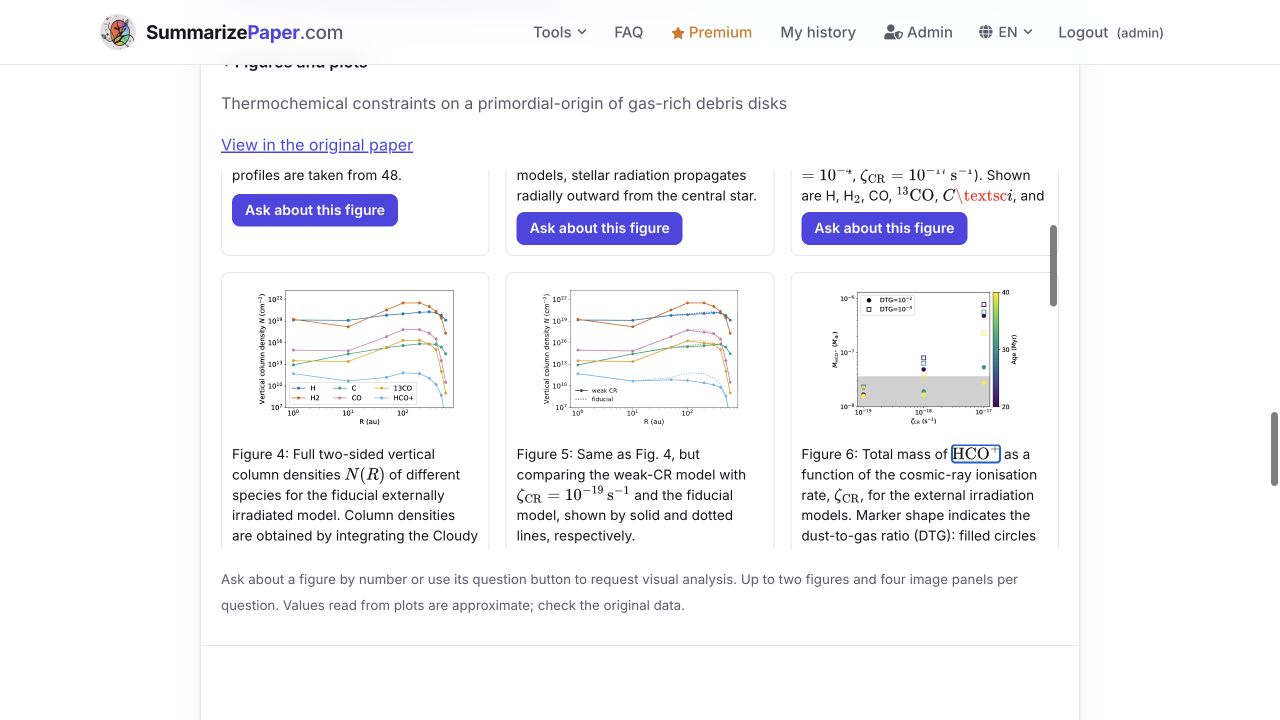
Expand Figures and plots. Figure 6, for example, compares HCO⁺ mass at different cosmic-ray ionisation rates. It lets you examine the physical conditions of a primordial-origin scenario beyond the single sentence citing a secondary-gas model. Enlarge a plot to inspect its axes, and use the PDF for the complete document.
8. Export the filtered set or save a reading task
Export (CSV) and Export (BibTeX) keep the active filters. CSV includes verdicts, explanations and excerpts; BibTeX provides bibliographic entries. If you want to discuss the two recent reuses at a meeting, export that filtered set.
To retain one paper, tick its checkbox, choose an existing collection or A new collection, enter a name and click Add. Here we keep the HD 166191 study.
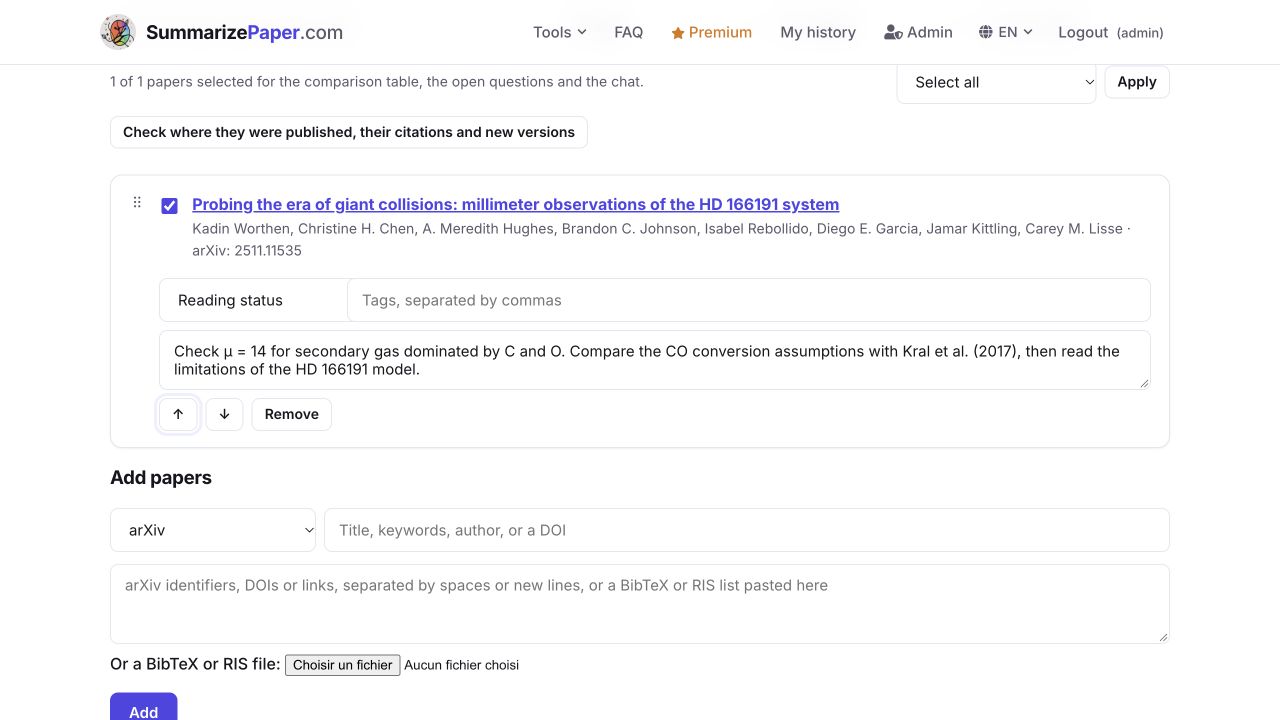
In the collection, set To read and add a note: check μ = 14, the CO conversion assumptions and the model limitations. That preserves the question that made the citation worth following up.
Continue with the Collections guide to build an annotated reading corpus. Scoop Watch complements citation tracking by finding related work that may never cite your reference.
Sources used in the examples
Excerpts and figures come from Mitani et al., Thermochemical constraints on a primordial-origin of gas-rich debris disks, Worthen et al., Probing the era of giant collisions: millimeter observations of the HD 166191 system and Hales et al., ALMA Observations of the HD 110058 debris disk, under CC BY 4.0. Original excerpts and figures are displayed within the interface; explanatory text is paraphrased. Scientific titles and source captions keep their original language.
Follow how a paper is used · Premium
Set up my citation alerts