
Scoop Watch: what does a close paper change about your project?
You plan to study the origin of gas in debris discs. A new paper asks a similar question through dust dynamics. An older paper models how primordial gas survives. Which is useful background, and which part of your project needs a sharper explanation?
Scoop Watch, available with Premium, compares papers with your project's question, method, data and expected results. This walkthrough follows an actual 28 October 2026 demonstration: an initial search, a more precise project description, a CC BY full-text comparison and a saved reading task. The project is fictional and contains no private data.
Describe a contribution, not just a topic
Open Scoop Watch. Give the project a title and at least 300 characters explaining what it will do. Our initial description combined a gas-evolution model with spatially resolved observations to distinguish gas-production mechanisms. It named no specific targets or new findings.
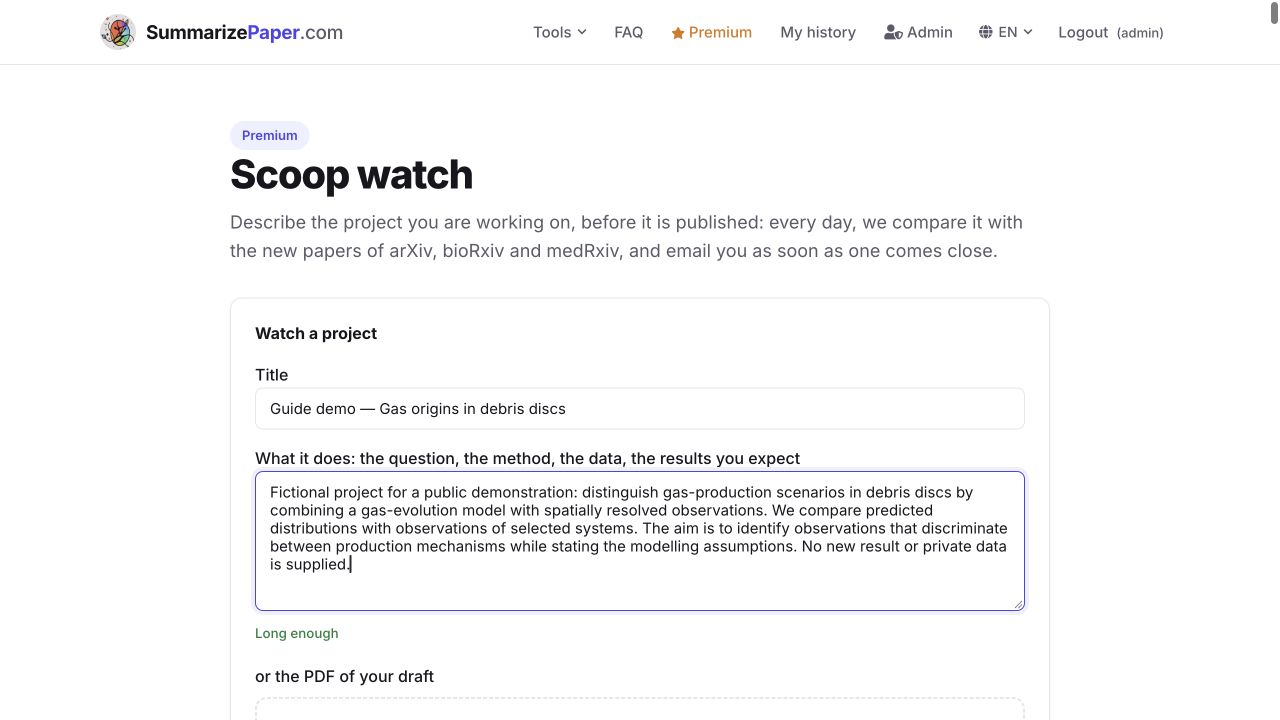
| Include | A useful question to answer |
|---|---|
| Question | Which competing explanations will you distinguish? |
| Method | What will you model, measure or compare? |
| Data | Which systems, observations or datasets will you use? |
| Expected result | What would this work add, without presenting a plan as a finding? |
You can also start from a draft PDF. The option to retain its text concerns later full-text comparisons. This demonstration used a written description only.
Set references, teams and a manageable alert frequency
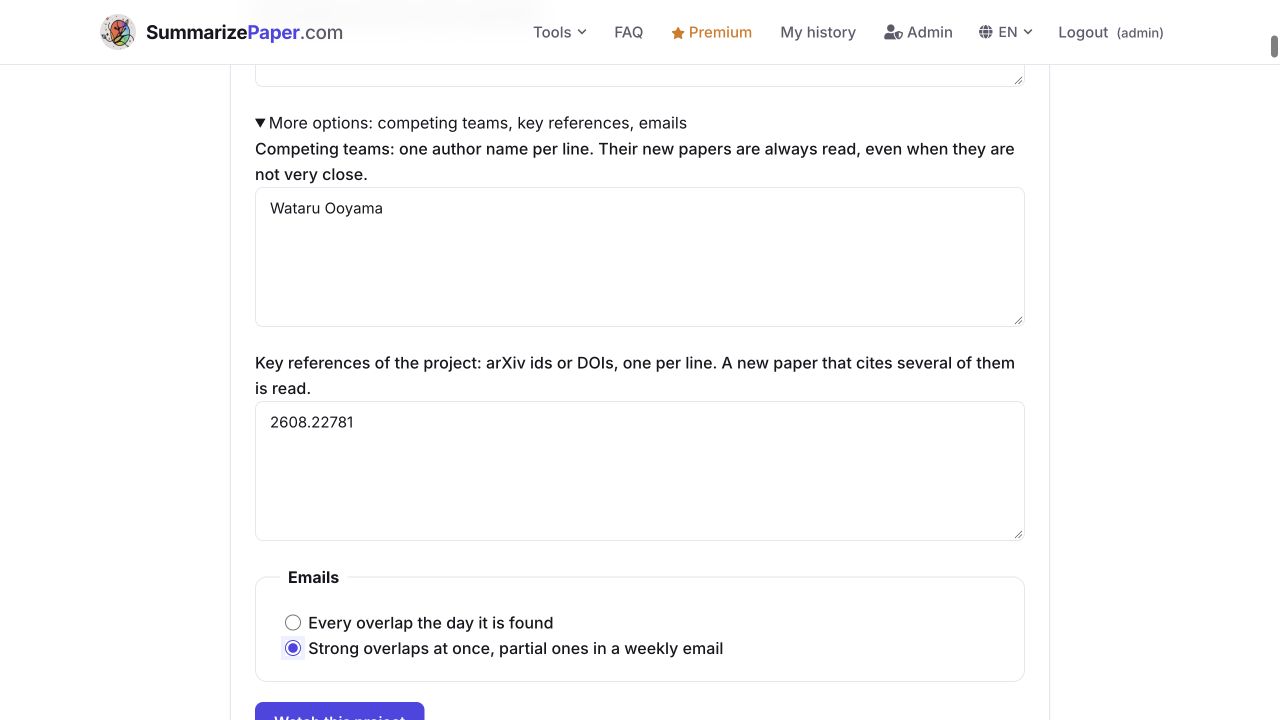
The options let you exclude your own work through coauthor names, follow particular authors and supply key references. New papers by followed authors are read even if their similarity is low; papers citing several key references can also enter the comparison.
The screenshot shows an unsaved example: Wataru Ooyama as a followed author, 2608.22781 as a known reference, and immediate emails for strong overlaps with partial overlaps grouped weekly. These option trials did not change the existing project's email settings.
Separate new announcements from prior work
“New papers” follows announcements. “Already published” searches the previous three years across arXiv, journals and OpenReview. The first check and prior-work results appear on the page; they are not evidence of an email alert received.
The new-paper list includes Unbound grains in gaseous debris discs. Its partial overlap concerns the shared gas-origin question, while its dust-halo diagnostic differs from the initially proposed gas-distribution comparison.
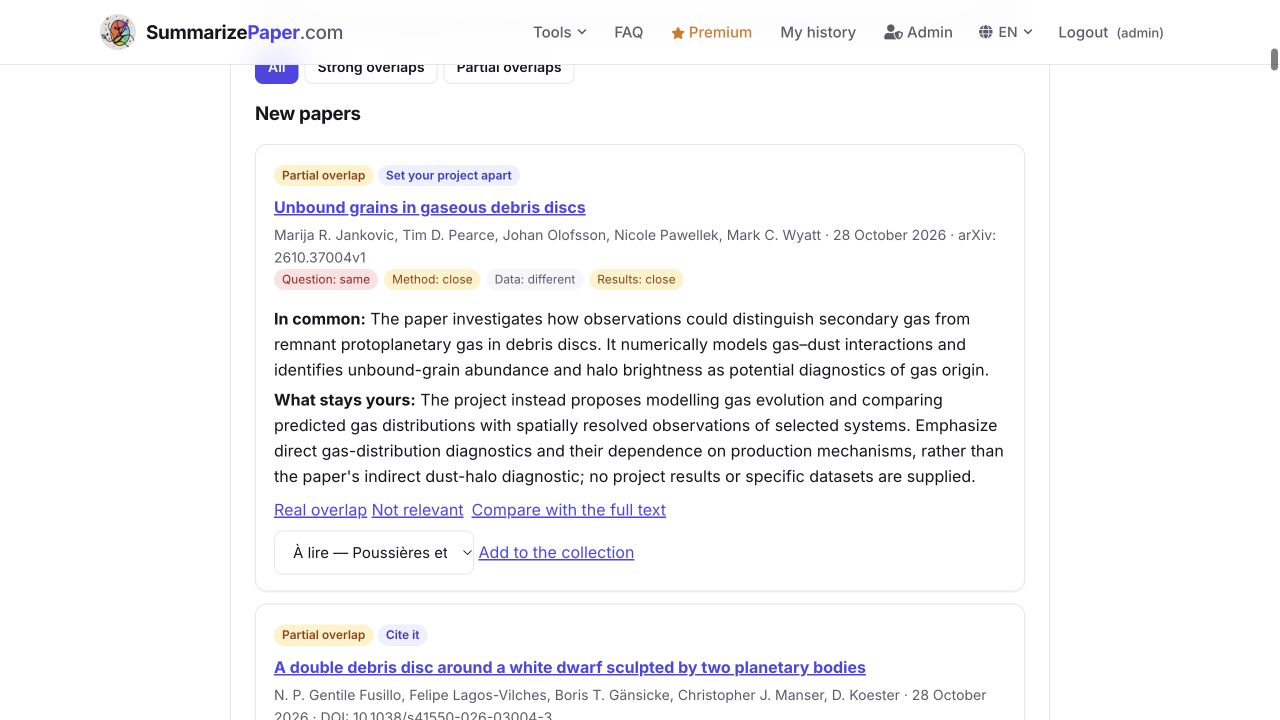
After retrying an interrupted search, the initial English example found 62 close papers, with the closest read by AI. The list can include preprint and journal versions of the same contribution: check identifiers before counting independent studies.
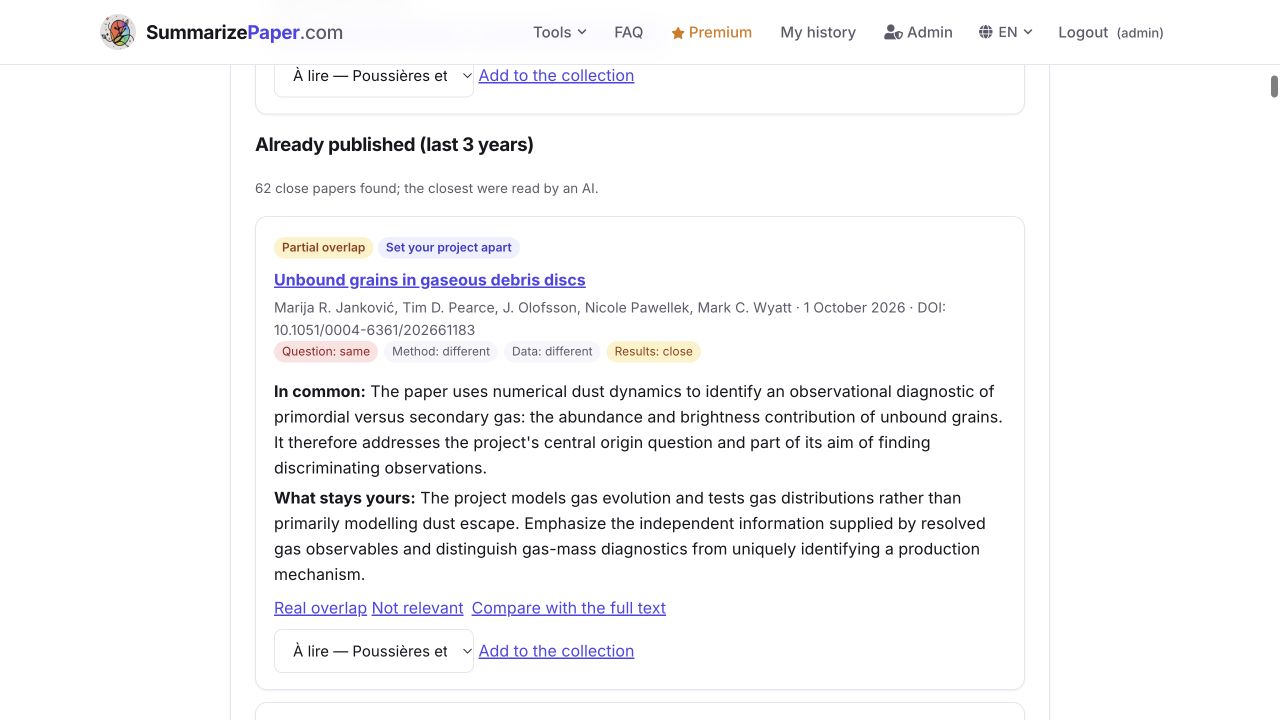
The first assessment uses abstracts. “All”, “Strong overlaps” and “Partial overlaps” filter the displayed matches. A search result count measures neither completeness nor the novelty of your project.
Refine the project when the first description is too broad
A vague description cannot establish whether papers use your intended data or method. We edited the demonstration to specify one-dimensional gas evolution, thermochemical calculations, CO and neutral-carbon radial profiles, HCO+ strengths, and matched beam and sensitivity treatment. It still makes no claim of new measurements or established findings.
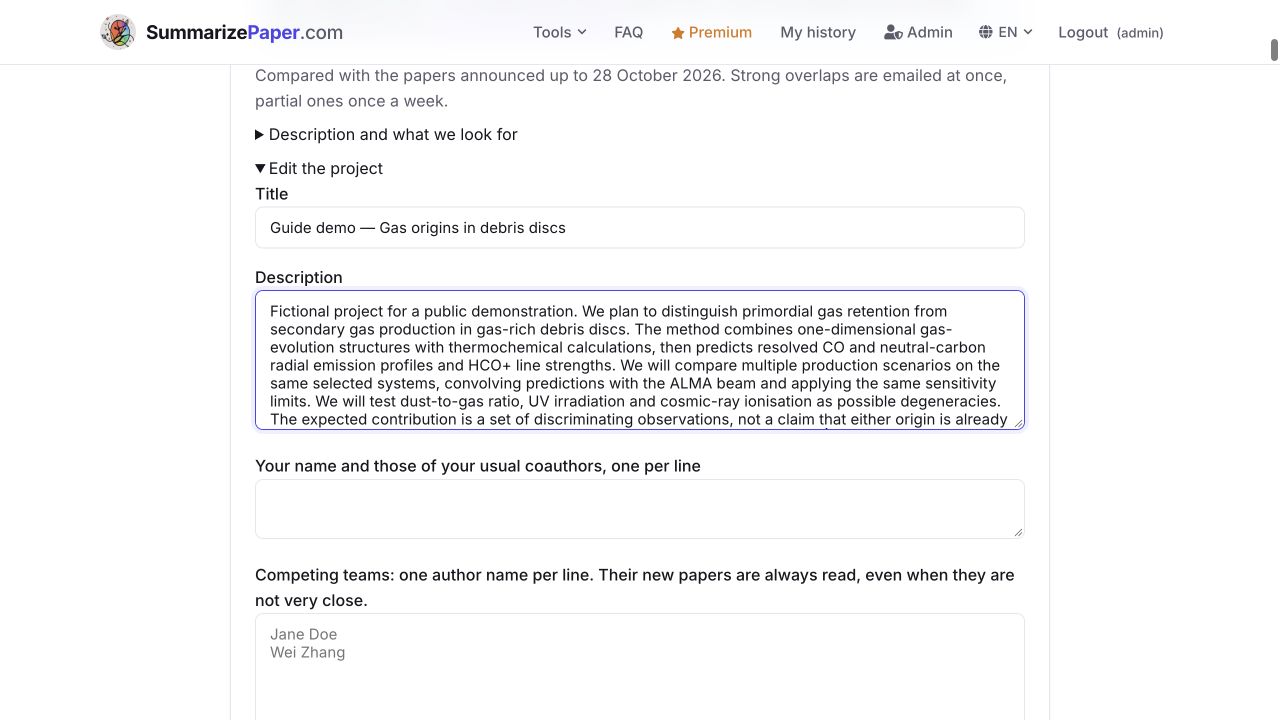
The new pass reported 58 close papers and added further comparisons. Earlier matches remain in the project; their original briefs are not automatically rewritten to reflect every edit. The numbers from successive passes should not be added as a count of unique studies.
A partial overlap can still be essential reading
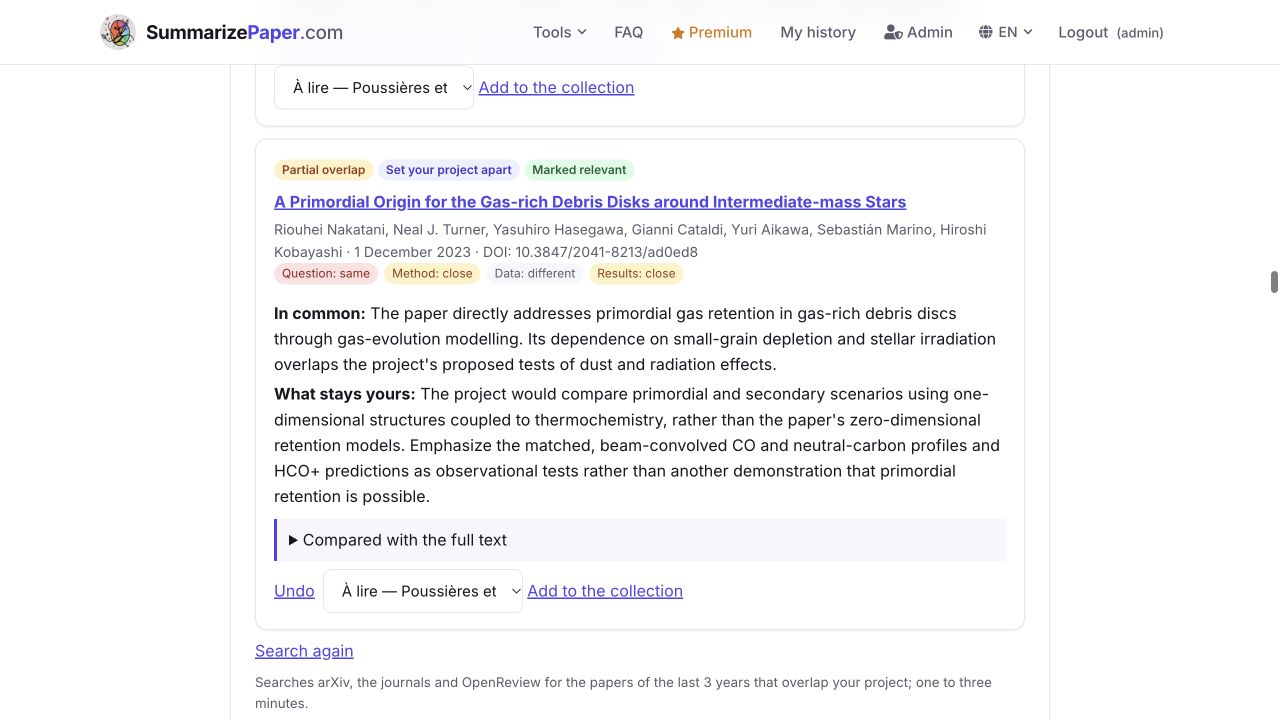
The refined search returned A Primordial Origin for the Gas-rich Debris Disks around Intermediate-mass Stars, by Nakatani et al., published in The Astrophysical Journal Letters in 2023, DOI 10.3847/2041-8213/ad0ed8, under CC BY 4.0.
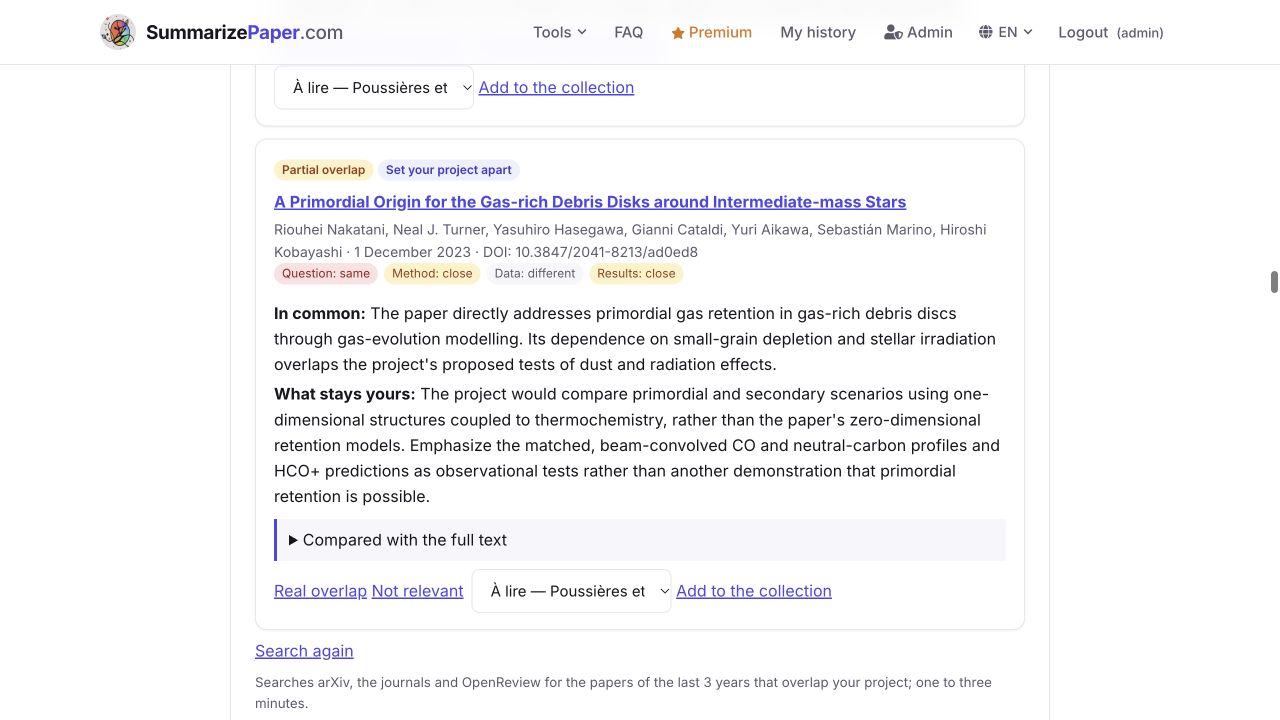
Read “In common” and “What stays yours” together. The latter suggests distinctions to verify; it does not certify originality. A partial overlap can deserve a citation and affect how you frame the project.
Read beyond the abstract before deciding what is new
Choose “Compare with the full text”. For this openly licensed paper, the completed comparison gives a question–method–data–results table and a more specific assessment. If full-text analysis is unavailable, use the abstract-level result with that limitation in mind.
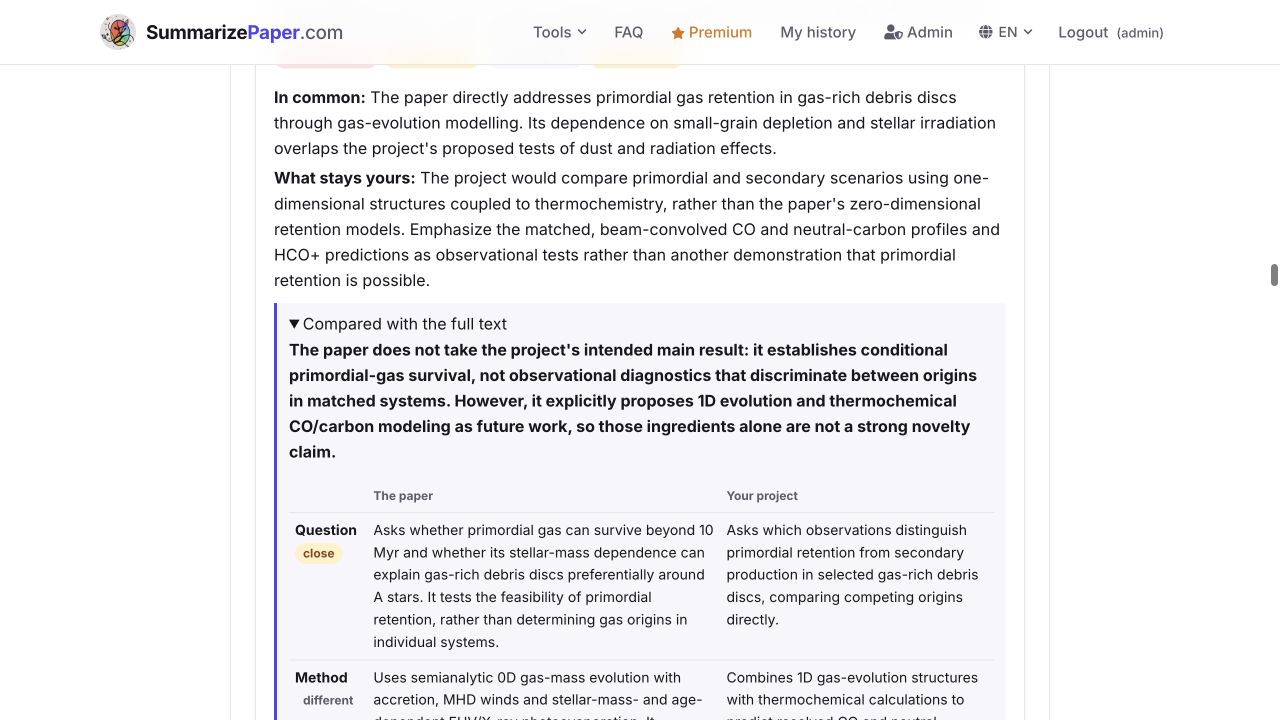
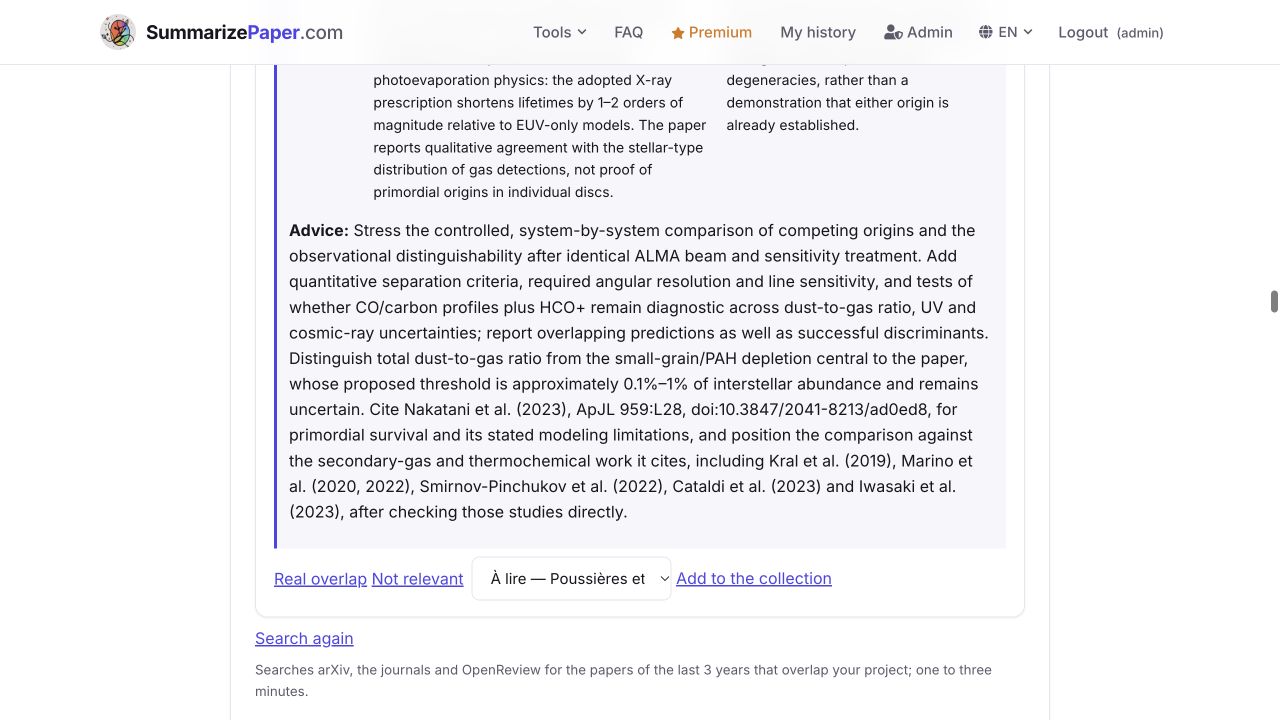
The practical advice is to define a controlled comparison of origins on matched systems and quantify whether the observations can separate them. Treat the advice as a reading and planning aid: inspect the cited paper and relevant methods before adopting it.
Check related full-text work and its figures
A useful follow-up is Mitani et al.'s thermochemical study, a CC BY 4.0 preprint submitted to arXiv on 24 August 2026. This is an additional reading example, separate from the Nakatani match above. Its source banner confirms full-text analysis; the displayed journal-submission comment is not an acceptance date.
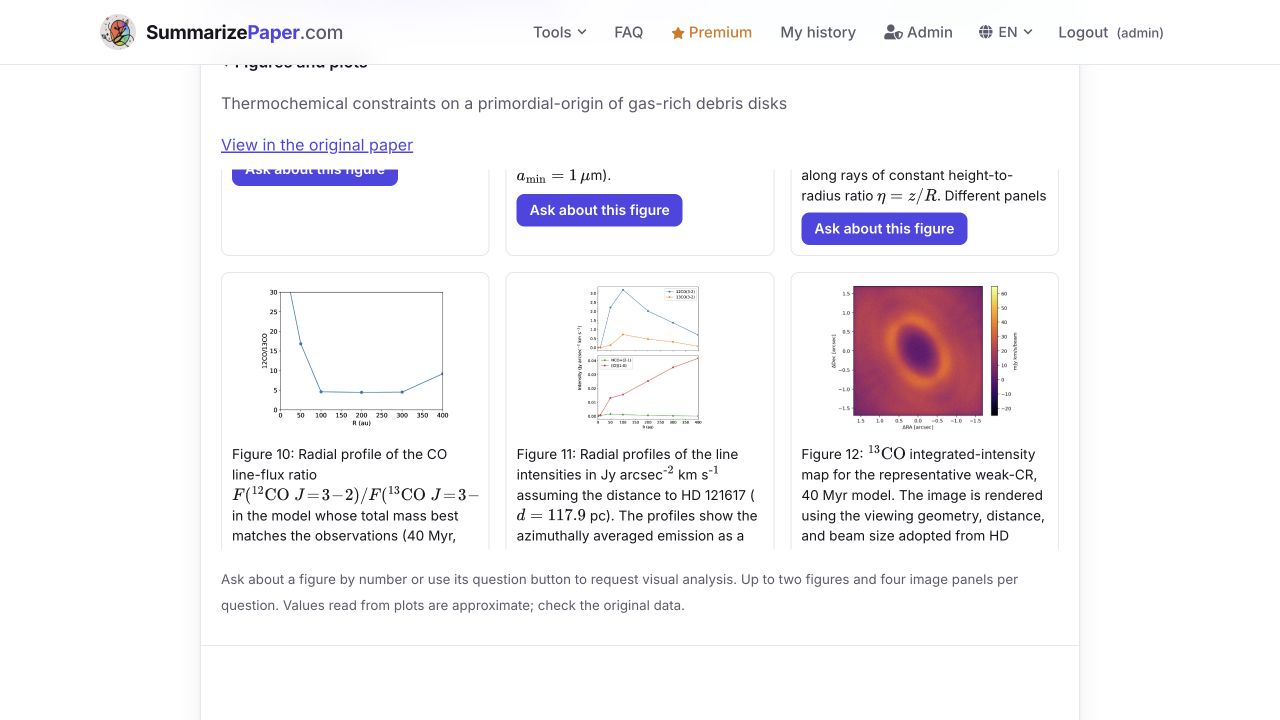
Open “Figures and plots” to inspect the radial profiles and the illustrative synthetic CO map. The authors' text explains how that image was constructed. A synthetic image is a model prediction, not a new observation.
Save the paper with the question it changes
We marked the Nakatani paper as a “Real overlap” in the demonstration project. This records relevance without changing the partial-overlap label. “Not relevant” reduces the weight of similar papers; “Undo” removes your feedback.
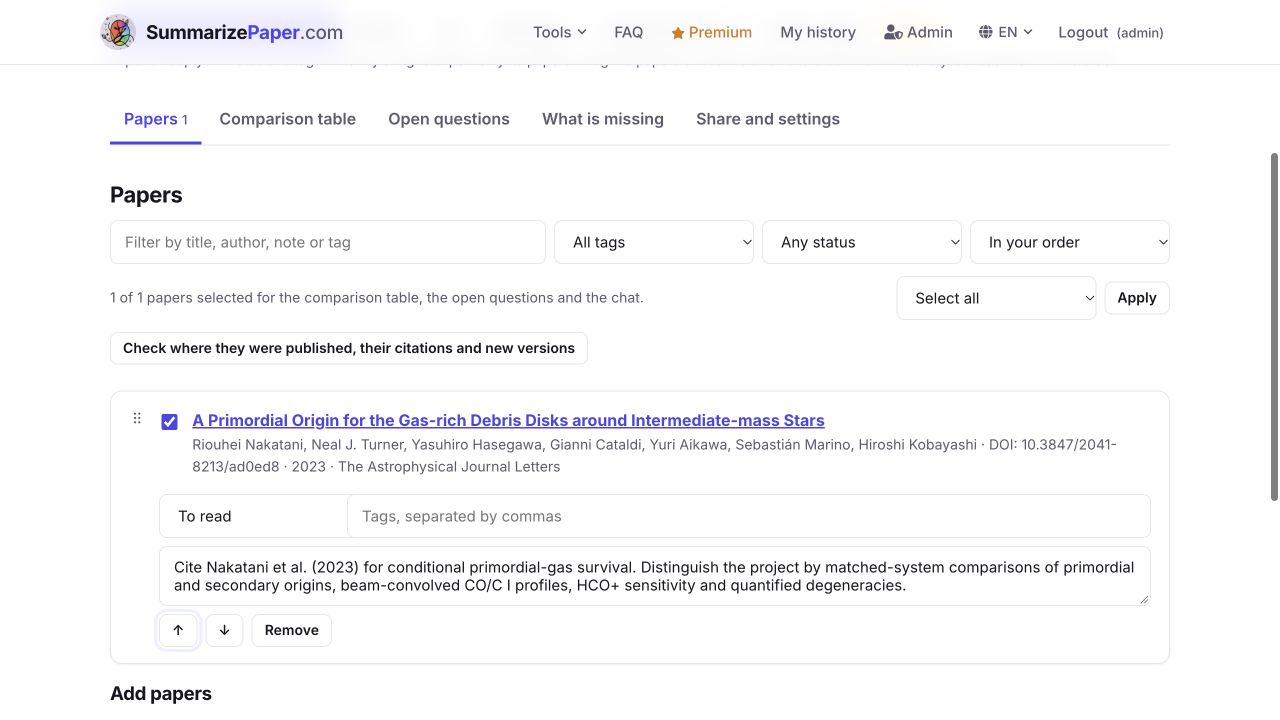
We added it to a new private collection, set “To read”, and noted what to cite and what to test: matched-system comparisons, spatial profiles, sensitivity and degeneracies. The note and status persisted after reloading.
Continue with the Collections guide to organize several papers, or chat with one paper to investigate a precise claim. Scoop Watch supports reading, citation and a clearer research plan; its comparisons do not establish priority or prove that an idea was appropriated.
Compare the literature with a specific project · Premium
Open Scoop Watch