
Literature review: from a research question to the papers that answer it, cited
Before a related-work section, a thesis chapter or a new project, you need the papers that matter on a question: the founding ones, the recent ones, and how they disagree. The literature review (Premium+) starts from your question, searches journals, preprint servers and arXiv, follows the references of the closest papers, and writes a synthesis grouped by approach in which every statement comes with the sentence that supports it.
This guide follows a real review, run on 10 November 2026, on a question still debated in our field: is the gas detected in debris discs left over from the protoplanetary disc, or released by colliding planetesimals?
1. Ask a precise question
Open the literature review and write your question, in any language. A question that names a phenomenon and the alternatives you want weighed gives a more focused review than a topic.
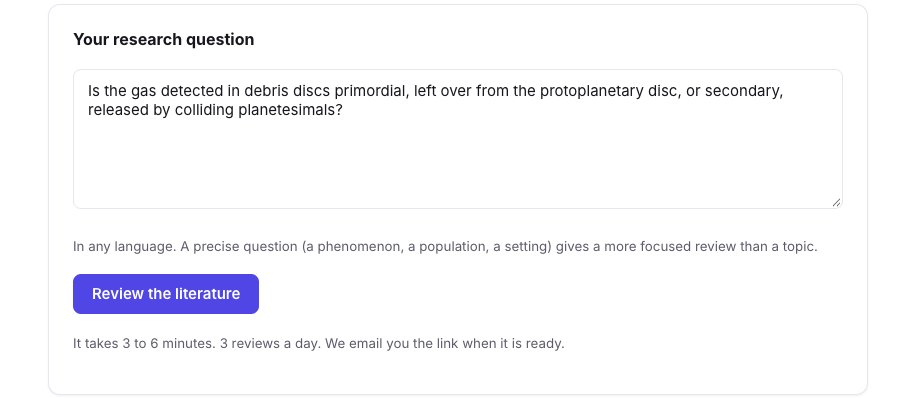
A review takes 3 to 6 minutes, and you get an email when it is ready; ours took five. You can run three a day.
2. See how it was searched
The page starts with what the review read. For our question: 296 papers found, the 80 closest screened on their abstract, 47 judged relevant and 30 included, from 2001 to 2026: 22 founding papers, 5 from the last three years and 2 reviews. 29 are published in a journal and one is a preprint; the conclusions of 13 open full texts were read too. And 18 of the 18 findings are backed by a sentence found word for word in a paper.
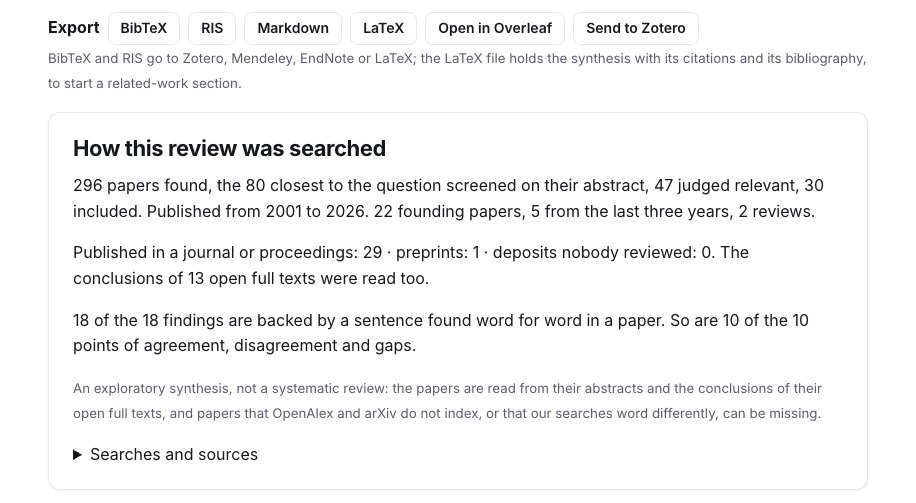
Searches and sources lists the queries written from your question, and where the candidates came from: the searches, the recent papers, the works cited by the closest papers, the papers that cite the founding ones.
3. Read the synthesis
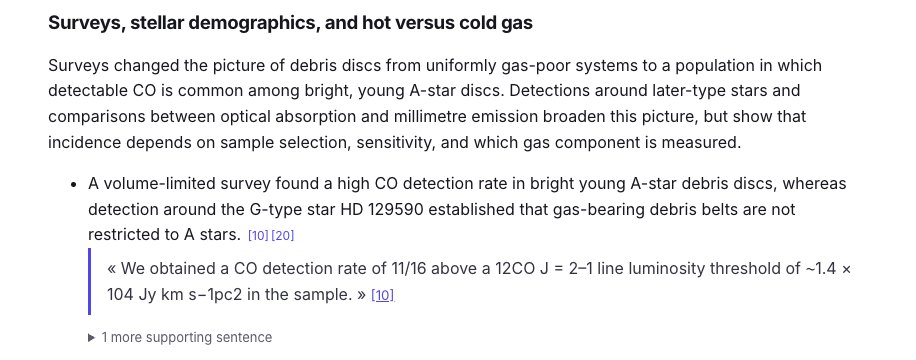
In short gives the answer in a few sentences, each with its references. Here: the papers support secondary gas in several discs, but do not establish a single origin for all of them, especially those with unusually large CO reservoirs. Then Approaches compared puts the six groups of papers side by side, with their strengths and their limits.
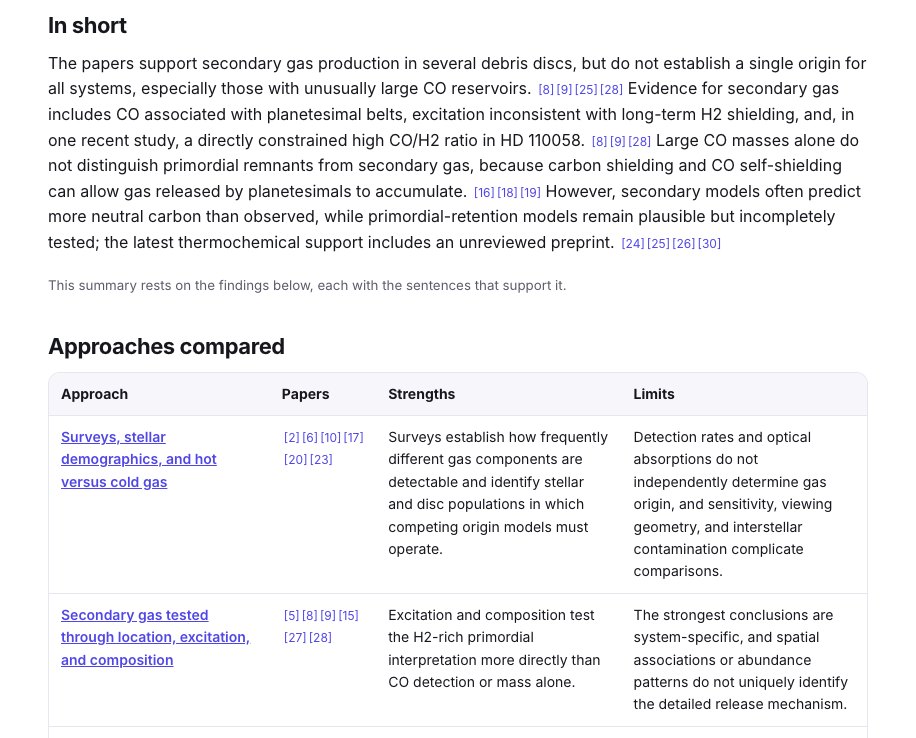
Each approach then has its own section: what its papers do, its findings, and under each finding the sentence of the paper that supports it, with its number in the references.
Where they disagree sets the sides of a debate against each other, each with its own papers and sentences. For our question, the review found the debate we expected (long-lived primordial remnants versus shielded secondary gas) and a second one, on the gas clump of β Pictoris.
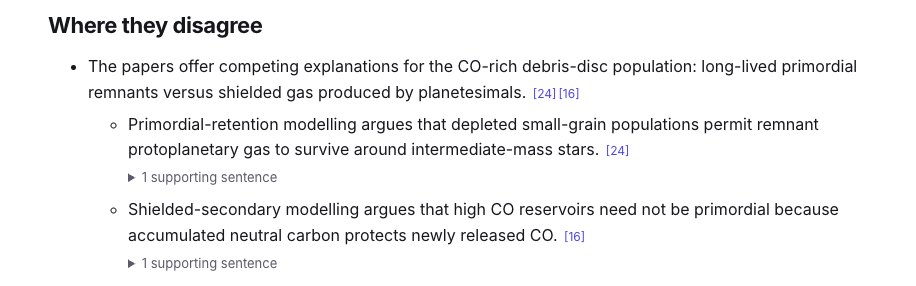
What they leave open lists the gaps, and Often cited, not read the works that many of the chosen papers cite but whose abstract no source gave: here Kiefer et al. (2014) on the exocomets of β Pictoris, Wyatt et al. (2015) and Zuckerman et al. (1995). Look them up yourself.
The review also says what each paper is: its 2026 thermochemical paper is marked a preprint, not peer reviewed, and the synthesis says so where it relies on it.
4. Check the references, and adjust the selection
Under References, each paper has its label (founding, recent, review), its approach and kind of study, why it is here, and its abstract with the quoted sentences marked.
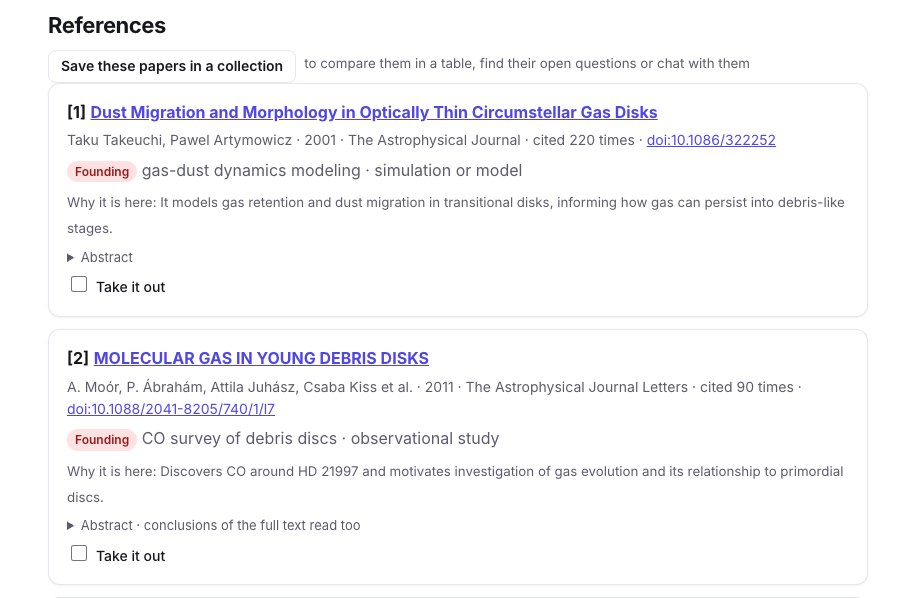
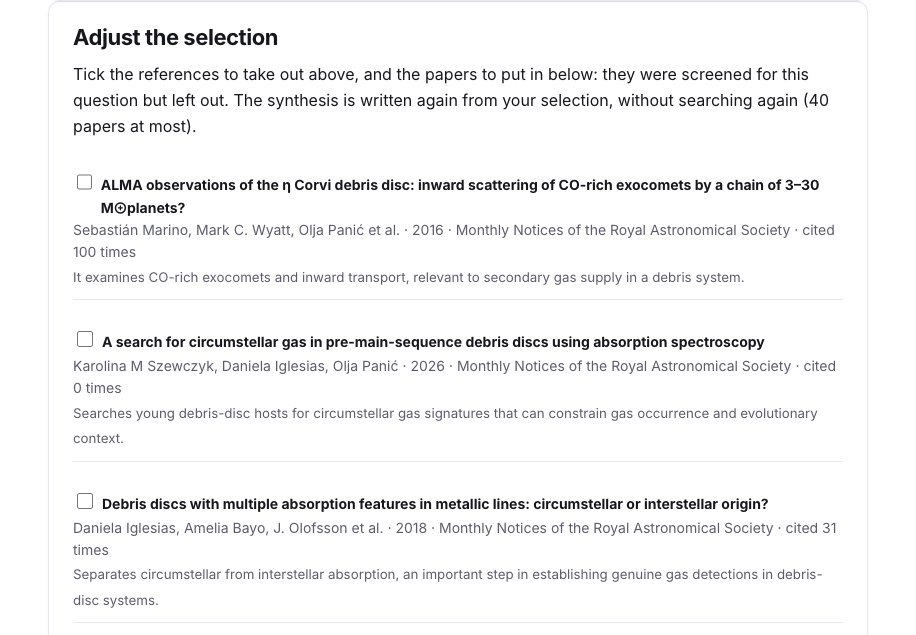
To change the selection, tick Take it out on the references you do not want, and put in papers from the 30 that were screened but left out, each with why it was considered. Write the synthesis again: the new review is written from your selection without searching again, on its own page.
5. Export it, and keep it up to date
- LaTeX and Open in Overleaf: the synthesis with its
\citecommands and its.bib, to start a related-work section; see the Overleaf guide. - BibTeX, RIS and Markdown: the references for any reference manager, or the synthesis as a note.
- Send to Zotero (with a connected library): a Zotero collection with a subcollection per approach, each paper with the statements it supports; see the Zotero guide.
- Save these papers in a collection, to chat with them or compare them in a table.
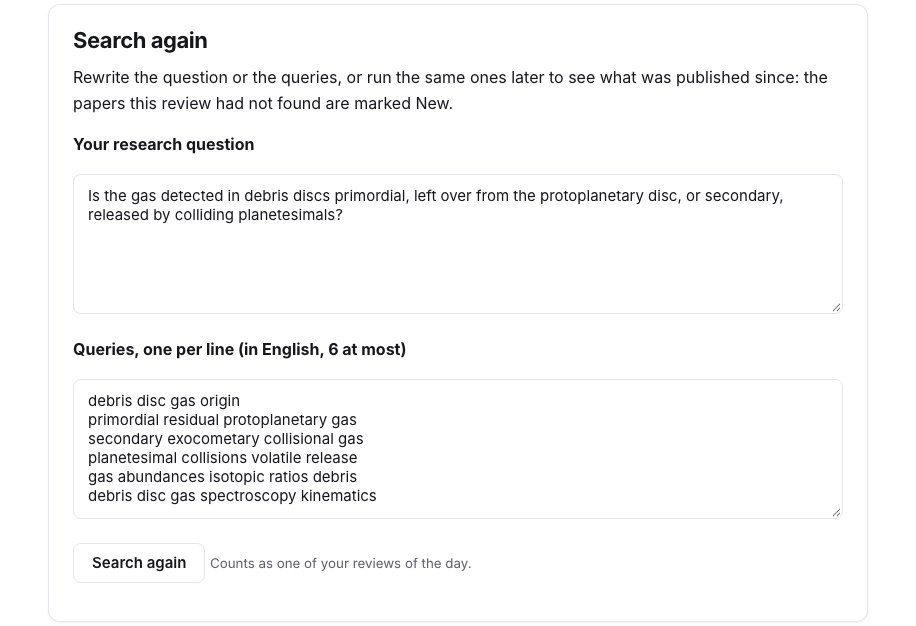
Search again reruns the same queries later, or new ones you write: the papers this review had not found are marked New.
From a collection
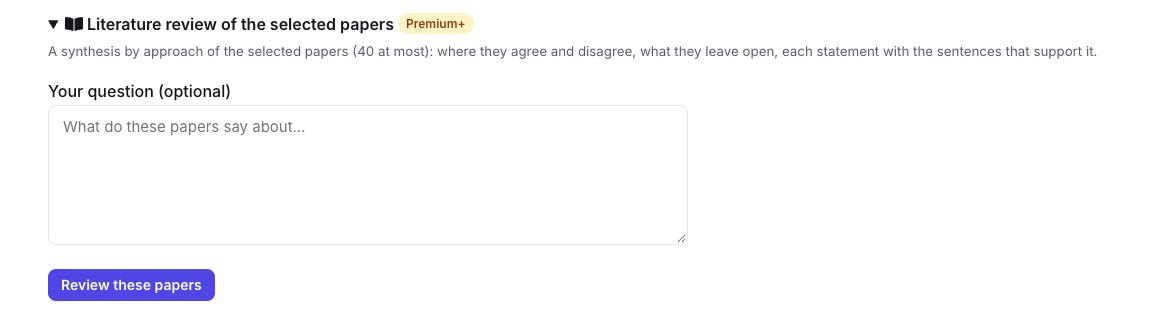
When you already have the papers, open a collection and choose Literature review of the selected papers: the synthesis is written from them (3 to 40), with or without a question, and no search is run.
Limits
- It is an exploratory synthesis, not a systematic review: papers are read from their abstracts and the conclusions of their open full texts.
- Two runs of the same question can choose slightly different papers: our French run of the same question kept 30 papers too, but not all the same, and grouped them into other approaches.
- A sentence found word for word shows that the paper says it, not that the paper is right: read the papers you cite.